How LocalPipe Went From #14 to #4 in AI Search in Two Weeks

Ricardo Matos
Case Study

How a B2B SaaS used Oppin’s Query Fan-Out data to turn hidden AI searches into a focused content strategy
LocalPipe knew its buyers were asking ChatGPT and other AI platforms for tools that could help them find and contact local business owners. What the team did not know was how often LocalPipe appeared in those answers, which competitors were being recommended instead, or what content could improve its position.
Before Oppin, checking AI visibility was manual and occasional. There was no reliable benchmark, no view of the searches happening behind each prompt, and no clear way to translate AI search data into a content plan.
After using Oppin to monitor its category and uncover Query Fan-Out data, LocalPipe built a focused SEO and GEO workflow around listicles, competitor comparisons, and specific tutorials. Within two weeks, LocalPipe moved from #14 to #4 among 45 brands in its tracked competitive set.
Results at a glance
Result | Reported outcome |
AI search rank | #14 to #4 out of 45 tracked brands |
Time to improvement | 2 weeks |
Visibility Score | +8.5 points |
GEO traffic | 2× growth |
Paying customers from combined GEO and SEO | Approximately 1–2 per day |
“It’s been a monumental improvement. We’ve gone up around 8.5 points, and we’re getting about two new paying customers every day from GEO and SEO.”
— Dylan Bond, Founder of LocalPipe
About LocalPipe
LocalPipe is a B2B lead generation platform that helps agencies and sales teams find local businesses and enrich their records with owner names, verified email addresses, direct phone numbers, and other contact data.
Because LocalPipe operates in a specialized software category, many prospects do not begin their journey with a specific brand in mind. They search for a solution to a problem, for example, "the best tool for finding local business owners", "an alternative to a general B2B database", or "a way to build a targeted HVAC lead list".
That makes visibility in Google and AI-generated recommendations a meaningful acquisition opportunity.
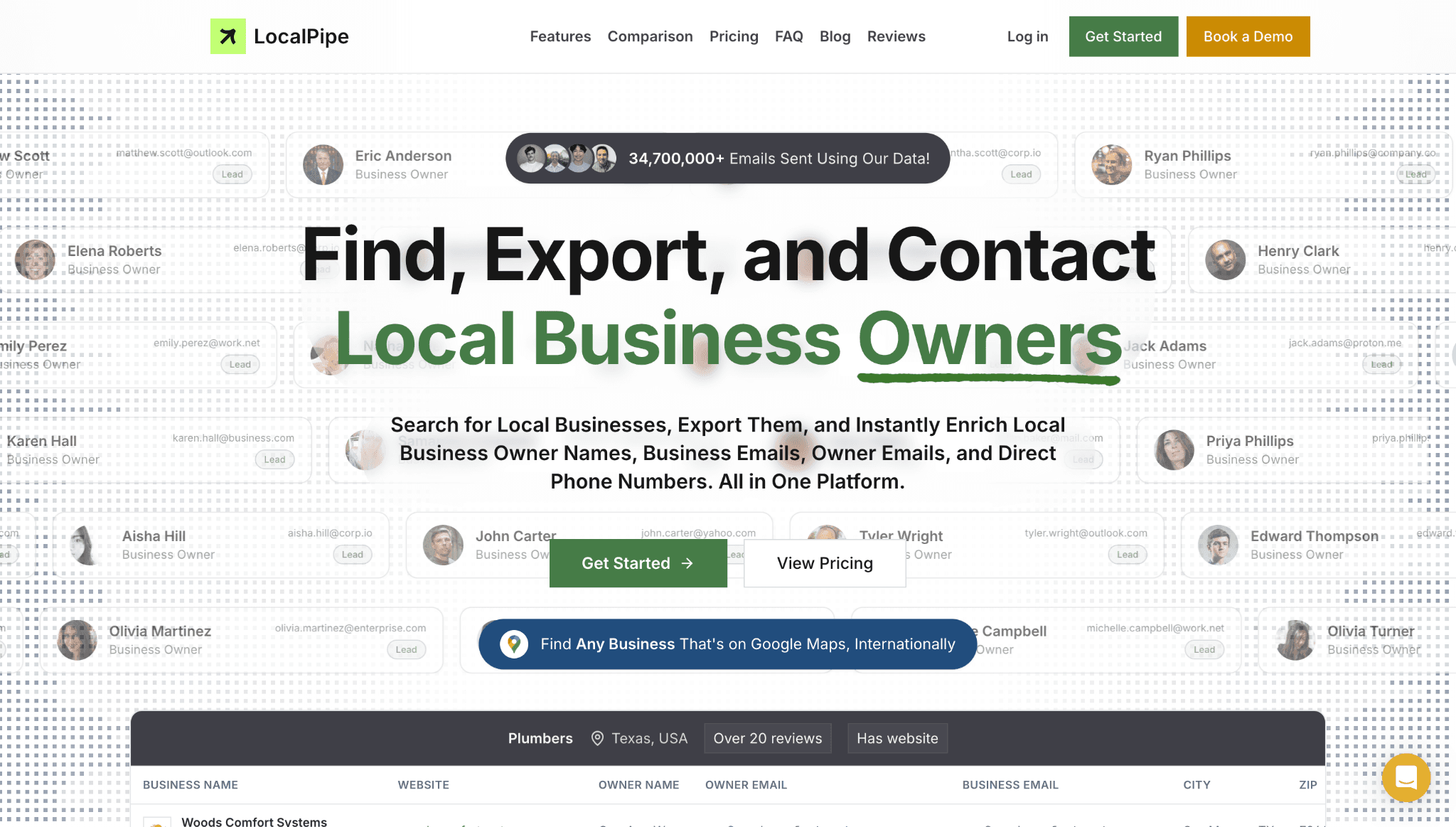
The challenge: LocalPipe could see conversions, but not the AI search journey
LocalPipe had already received customers from AI search. That early signal suggested the channel could work, but the team lacked the data needed to approach it systematically.
Manual checks could show whether LocalPipe appeared in one answer at one moment. They could not answer the questions needed to build a strategy:
How often does LocalPipe appear across commercially relevant prompts?
Where does it rank compared with direct and indirect competitors?
Which topics and use cases produce the biggest visibility gaps?
What does an AI model search for before composing its answer?
Which content formats and sources influence the brands it recommends?
This matters because AI search can deliver visitors who are already comparing options. Google says people use AI Mode for nuanced research and complex comparisons, and that its AI features may issue multiple related searches before generating an answer. Google also reports that clicks from results with AI Overviews tend to be higher quality, with visitors more likely to spend more time on the destination site. (Google Search Central)
The conversion potential is not universal, but one SaaS example illustrates the opportunity: Ahrefs reported that AI search generated only 0.5% of its traffic during a 30-day period but accounted for 12.1% of signups. On Ahrefs’ own site, that represented a 23× higher conversion rate than traditional organic search. (Ahrefs study)
LocalPipe needed to see the questions and sources shaping that high-intent discovery process.
Why did LocalPipe choose Oppin?
The first useful signal was the competitive benchmark.
Oppin showed LocalPipe where it ranked against other brands, how frequently it was mentioned, how often it appeared in the top three, and how its visibility changed over time. Instead of treating a handful of manual searches as evidence, the team had a consistent view of performance across its tracked prompts.
For Dylan, the most useful measurements were:
Mention rate: the share of tracked AI responses that mentioned LocalPipe.
Competitor ranking: LocalPipe’s position within the broader market tracked in Oppin.
Top-3 performance: how often LocalPipe appeared among the first three brands in an answer.
Visibility Score: the percentage of tracked AI responses in which the brand appeared. See how Oppin calculates AI visibility.
The rankings established the baseline. The feature that changed LocalPipe’s content workflow was Query Fan-Out.
The turning point: turning Query Fan-Out into content opportunities
When an AI system receives a complex prompt, it may break that request into several narrower searches. Google calls this the query fan-out technique: issuing multiple related searches across subtopics and data sources to build a response. (Google Search Central)
Oppin’s Query Fan-Out analysis captures the behind-the-scenes searches exposed by supported AI platforms. Instead of guessing which keywords might matter, LocalPipe could inspect the language AI systems were actually using to research its category.
This gave the team two valuable inputs:
Demand: the specific searches generated from broader buyer prompts.
Gaps: searches and themes where competitors appeared but LocalPipe did not.
As Dylan explained during our interview:
“Query Fan-Out shows us what ChatGPT is actually searching for. We export that data, give it to Claude, and use it to identify the best areas to cover.”
That changed the content question from “What should we write next?” to “Which recurring AI search gaps should we address first?”
LocalPipe’s SEO and GEO content workflow
LocalPipe built a lean process around Oppin data rather than adding more disconnected marketing tools.
1. Export Query Fan-Out data from Oppin
The team exports the underlying queries so they can group them by topic, intent, competitor, and use case. Oppin supports table-level exports as well as full brand datasets in spreadsheet, CSV, and JSON formats. See how to export Oppin data.
2. Analyze the data in Claude
LocalPipe gives the exported dataset to Claude and asks it to identify repeated themes, commercially relevant gaps, and content opportunities. This helps the team prioritize clusters rather than creating one page for every variation of a query.
3. Create three types of high-intent content
The resulting briefs feed three repeatable formats:
Content type | Purpose | LocalPipe example |
Tool listicles | Become relevant to “best,” “top,” and category-discovery queries | “7 Best Google Data Enrichment Tools” |
Competitor comparisons | Address buyers actively evaluating alternatives | “Apollo vs. LocalPipe” |
Specific tutorials | Match problem-led and use-case searches | “How to Find HVAC Leads” |
These formats map naturally to ranking, comparison, and how-to intent, the same types of intent Oppin identifies in fan-out queries.
4. Ground every draft in internal research
LocalPipe uses Oppin’s insights, but it does not rely on generic AI output. The team supplies internal research in Markdown files so each article reflects the product, market, use case, and available evidence.
This step is important. The value of Query Fan-Out is not simply producing more content; it is producing pages that answer the specific questions AI systems and buyers are researching.
5. Accelerate discovery and indexing
After publishing, LocalPipe uses IndexRusher to speed up discovery through Google and Bing sitemaps. Google notes that a page must be indexed and eligible to appear in Search before it can be shown as a supporting link in AI Overviews or AI Mode. (Google Search Central)
6. Measure movement in Oppin
LocalPipe returns to Oppin to review changes in visibility, mentions, top-three appearances, and competitor position. This closes the loop between research, publishing, and measurement.
The results: from #14 to #4 in two weeks
After two weeks of consistent GEO work, LocalPipe reported:
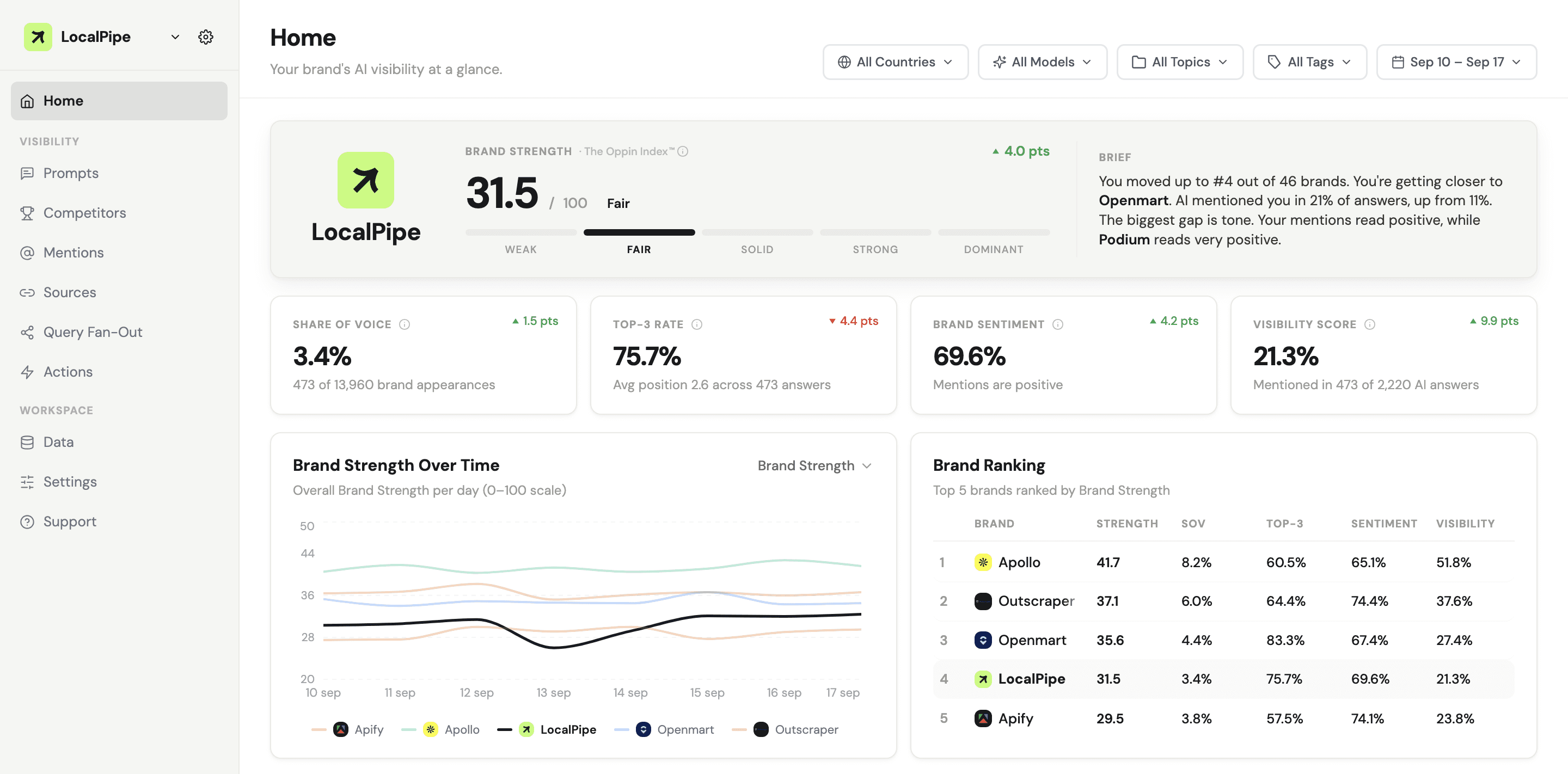
A move from #14 to #4 out of 45 brands in its Oppin-tracked category.
An 8.5-point increase in Visibility Score.
A doubling of GEO traffic.
Approximately 1–2 new paying customers per day from GEO and SEO combined.
Dylan also shared the result publicly in a LinkedIn post documenting LocalPipe’s move from #14 to #4. In that post, he highlighted tool listicles and direct competitor comparisons as the two formats driving the strategy.
The outcome did not come from tracking alone. LocalPipe combined Oppin’s insights with fast execution, original product knowledge, consistent publishing, and an indexing workflow. Oppin made the opportunity visible and gave the team a way to measure whether the work was changing its competitive position.
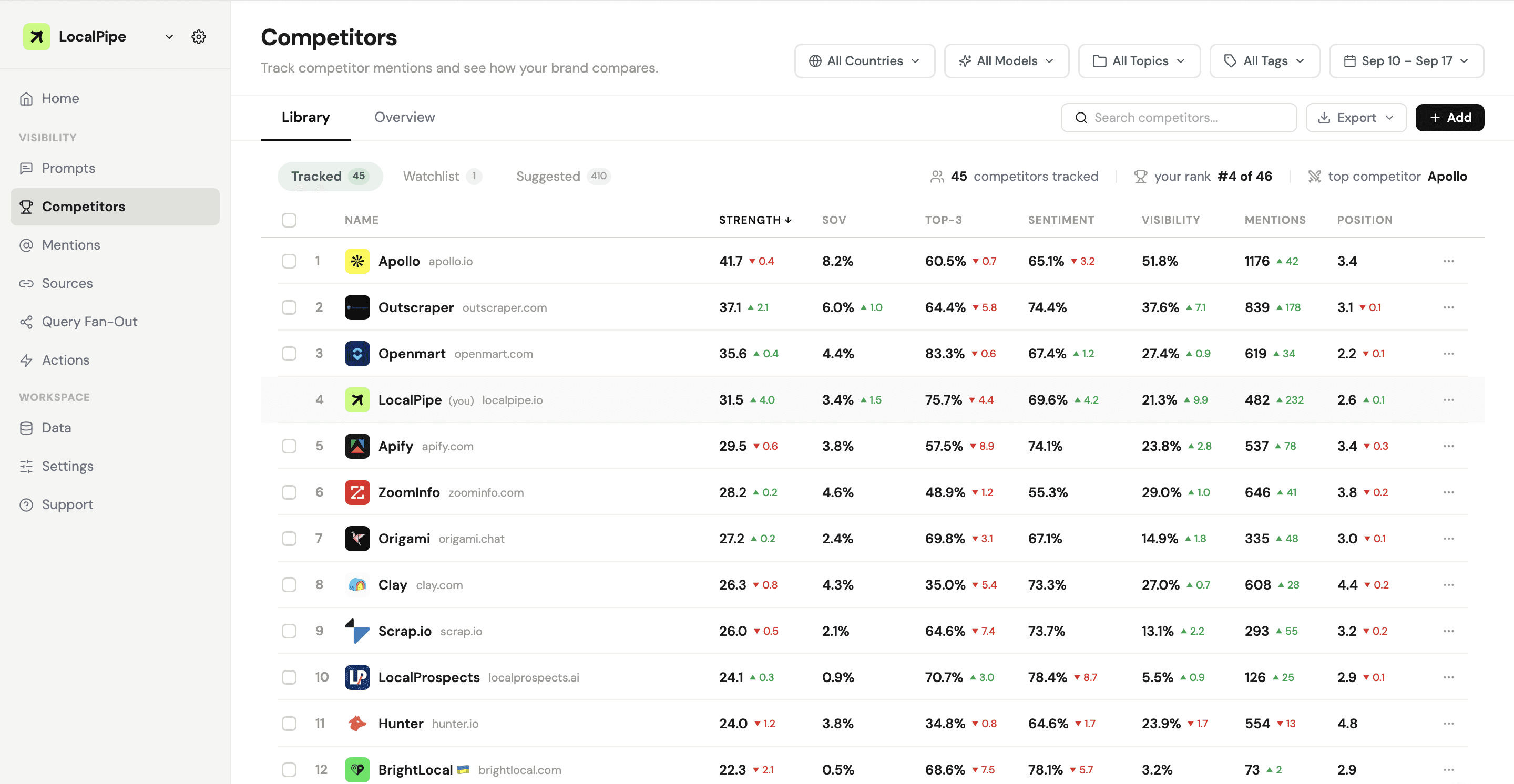
After using Oppin’s insights for their content strategy. (Sept. 10 - Sept. 17)
LocalPipe became the #1 source used by AI in its category
The improvement was not limited to brand mentions or competitive ranking. LocalPipe’s own website also became a much more influential part of the source landscape behind the AI responses Oppin tracked.
During the first week, from August 27 to September 3, localpipe.io was the #3 most-used domain across the tracked prompts. AI models retrieved the domain 653 times, giving LocalPipe a 4.5% share of all source usage and 12.4% coverage across the responses analyzed.
By September 10–17, after LocalPipe had published more content aligned with the topics and queries uncovered through Oppin, localpipe.io had become the #1 most-used domain. Its pages were retrieved 2,752 times, its source share increased to 9.2%, and its coverage reached 27.9%.
Source metric | Aug. 27–Sep. 3 | Sep. 10–17 | Change |
Rank among domains used as sources | #3 | #1 | Up 2 positions |
Times used | 653 | 2,752 | 4.2× higher |
Share of source usage | 4.5% | 9.2% | +4.7 percentage points |
Coverage across tracked responses | 12.4% | 27.9% | +15.5 percentage points |
This distinction matters. LocalPipe was not only appearing more frequently in final answers; its website was increasingly part of the research layer AI models used to construct those answers. The movement is consistent with the team’s strategy of using Query Fan-Out data to create content around the subjects AI systems were already investigating.
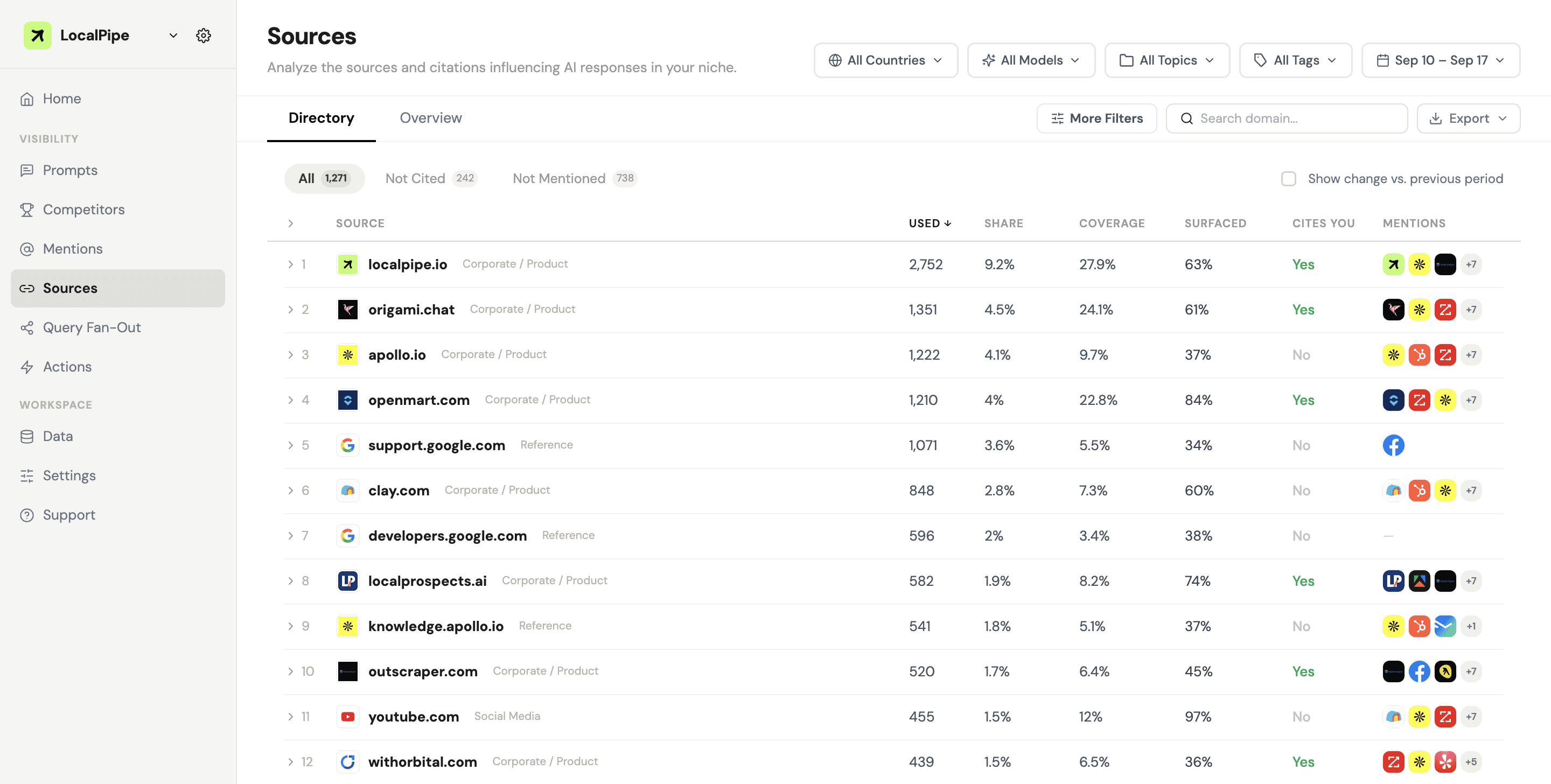
After using Oppin’s insights. (Sept. 10 - Sept. 17)
Why this strategy worked?
It started with observed demand, not a generic keyword list
Traditional keyword research remains useful, but it does not always reveal the chain of searches an AI system performs before recommending a product. Query Fan-Out exposed those intermediate questions and gave LocalPipe a broader view of category demand.
It prioritized content close to a buying decision
“Best tools,” “X vs. Y,” and use-case tutorials often signal that a buyer is discovering vendors or evaluating a shortlist. LocalPipe focused on those high-intent moments rather than chasing traffic without a clear path to the product.
It combined GEO and SEO
The team did not treat generative engine optimization as a replacement for search engine optimization. The same pages needed to be crawlable, indexed, useful to people, supported by internal knowledge, and relevant to traditional search. Google explicitly says its existing SEO fundamentals still apply to AI Overviews and AI Mode. (Google Search Central)
It measured trends against real competitors
AI answers vary. A single manual check can produce a misleading snapshot. Oppin’s competitor analytics let LocalPipe follow changes over time and compare its performance across the full tracked field.
A repeatable GEO playbook for B2B SaaS teams
LocalPipe’s workflow can be adapted by other SaaS teams:
Choose buyer prompts, not vanity keywords. Track questions people ask when discovering, comparing, or selecting tools.
Establish a baseline. Record visibility, mentions, top-three rate, sources, and competitor rank before making changes.
Export Query Fan-Out gaps. Group related searches by intent and theme.
Prioritize commercial clusters. Start with listicles, comparisons, alternatives, and specific use cases that connect naturally to the product.
Add first-party knowledge. Use product data, customer insights, screenshots, examples, and internal research to make each page genuinely useful.
Publish with SEO fundamentals in place. Make pages crawlable, indexable, internally linked, and easy to understand.
Measure over weeks, not individual days. AI responses are variable; trends are more useful than one-off checks.
Repeat what moves the right metrics. Refresh successful formats and investigate the sources behind competitors that continue to win.
From a black box to a measurable growth channel
Before Oppin, LocalPipe knew AI search could produce customers but did not have a repeatable way to study or improve its presence.
Oppin gave the team a competitive baseline, visibility metrics, and most importantly for its workflow, the Query Fan-Out data needed to identify content gaps. LocalPipe then turned those insights into focused content and measured the result.
In two weeks, the company moved from #14 to #4 in its tracked AI search category. More importantly, its combined GEO and SEO channel was producing approximately one to two new paying users per day.
For a lean B2B SaaS team, that is the real value of AI search visibility data: not another dashboard, but a clearer answer to what to create, why it matters, and whether it is working.
Want to find the prompts, sources, and hidden queries influencing recommendations in your category? Start tracking your AI search visibility with Oppin.
Frequently asked questions
What is Query Fan-Out?
Query Fan-Out is the process an AI search system uses to break a broad question into multiple related searches across subtopics and data sources. Oppin captures the fan-out queries exposed by supported AI platforms so teams can find demand, content gaps, and competitor opportunities.
How did LocalPipe improve its AI search ranking?
LocalPipe exported Query Fan-Out data from Oppin, analyzed the queries in Claude, and used the resulting gaps to create tool listicles, competitor comparisons, and specific tutorials. The team also grounded drafts in internal research and accelerated search-engine discovery after publishing.
How quickly did LocalPipe see results?
LocalPipe reported moving from #14 to #4 among 45 tracked brands after two weeks of consistent GEO work. Its Visibility Score increased by 8.5 points over the period.
Did Oppin create the content for LocalPipe?
No. Oppin supplied the visibility, competitor, source, and Query Fan-Out insights that guided the strategy. LocalPipe used Claude, SEO Bot, internal research, and its own publishing workflow to create and distribute the content.
What is the difference between SEO and GEO?
SEO improves how content is discovered and ranked by traditional search engines. GEO focuses on how brands and content are understood, cited, and recommended in AI-generated answers. In practice, they overlap: strong technical SEO, helpful content, clear product information, and credible external mentions can support both.