How to Measure AI Share of Voice Using Oppin

Ricardo Matos
How to guides

TL;DR AI Share of Voice measures how much of the brand conversation in AI-generated answers belongs to your company compared with competitors.
With Oppin, you can monitor these metrics across ChatGPT, Gemini, Perplexity, Google AI and other AI platforms, then break the results down by model, country, language and topic.
In Oppin, Share of Voice is calculated as:
AI Share of Voice = (Answers mentioning your brand ÷ Total brand appearances across analyzed answers) × 100
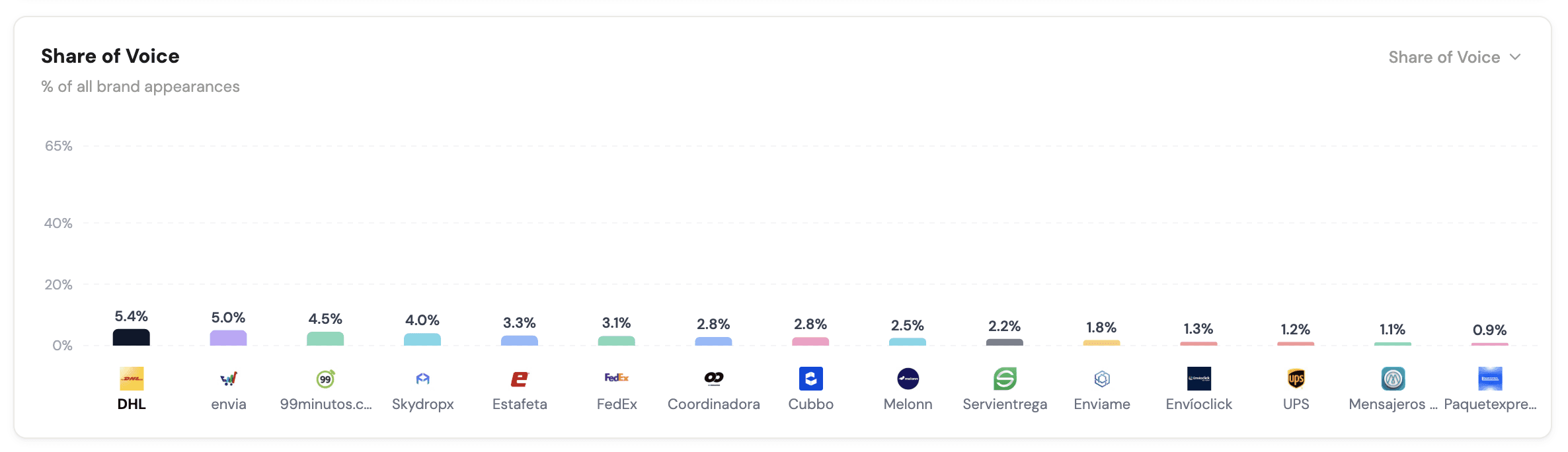
But Share of Voice becomes much more useful when you analyze it alongside other metrics such as Visibility, Position, Top 3 Rate, Citations and Sentiment.
With Oppin, you can monitor these metrics across ChatGPT, Gemini, Perplexity, Google AI and other AI platforms, then break the results down by model, country, language and topic.
The goal is not simply to know whether AI mentions your brand.
It is to understand how much of the conversation you own, where competitors are outperforming you and what opportunities you can act on.
What Is AI Share of Voice?
AI Share of Voice, or AI SoV, measures your brand's presence in AI-generated recommendations relative to other companies competing for the same conversations.
Think of it as market share for AI answers.
Imagine someone asks:
“What are the best CRM platforms for startups?”
An AI assistant might recommend five different platforms.
If your company consistently appears in those responses, your visibility is strong.
But if several competitors appear much more frequently, your overall Share of Voice may still be relatively low.
That's why raw mentions don't tell the full story.
Knowing that your brand appeared 400 times sounds positive.
Knowing that your competitors accumulated 2,000 appearances across the same dataset gives that number context.
Mentions tell you whether AI talks about you.
Share of Voice tells you how much of the competitive conversation you own.
How Is AI Share of Voice Calculated?
Oppin calculates AI Share of Voice based on the portion of brand appearances your company captures across the AI responses being monitored.
The formula is:
Share of Voice = (Answers mentioning your brand ÷ Total brand appearances) × 100
Each brand counts once per answer, even if its name appears multiple times within the same response.
AI Share of Voice example
Imagine Oppin analyzes a group of AI responses and detects 250 total brand appearances.
Your company appears in 50 of those answers.
Your Share of Voice would be:
50 ÷ 250 × 100 = 20%
Your brand therefore captured 20% of the total brand attention within that set of monitored conversations.
This is different from simply saying that you appeared in 50 responses.
The Share of Voice percentage shows how those appearances compare with the rest of the market.
Why AI Share of Voice Matters
Search behavior is changing, traditional SEO tools are useful for tracking rankings and organic search performance, but AI visibility requires a different set of metrics. We explain those differences in more detail in our Oppin vs Semrush comparison.
People increasingly use AI platforms to research products, compare providers and ask for recommendations.
Instead of searching ten different websites, someone can ask:
What is the best software for my use case?
Which company should I choose?
What are the best alternatives to this product?
Which providers offer this feature?
What solution is best for a small business?
AI systems can summarize the market before the user ever reaches a company's website.
That creates a new competitive question for marketing teams:
How often does AI recommend us when buyers ask questions related to our category?
AI Share of Voice helps answer that.
Benchmark your brand against competitors
Your visibility percentage doesn't mean much without competitive context.
Suppose your brand appears in 25% of monitored responses.
That could be excellent if your closest competitor appears in only 12%.
It could also be weak if the market leader appears in 65%.
Share of Voice helps you understand the difference.
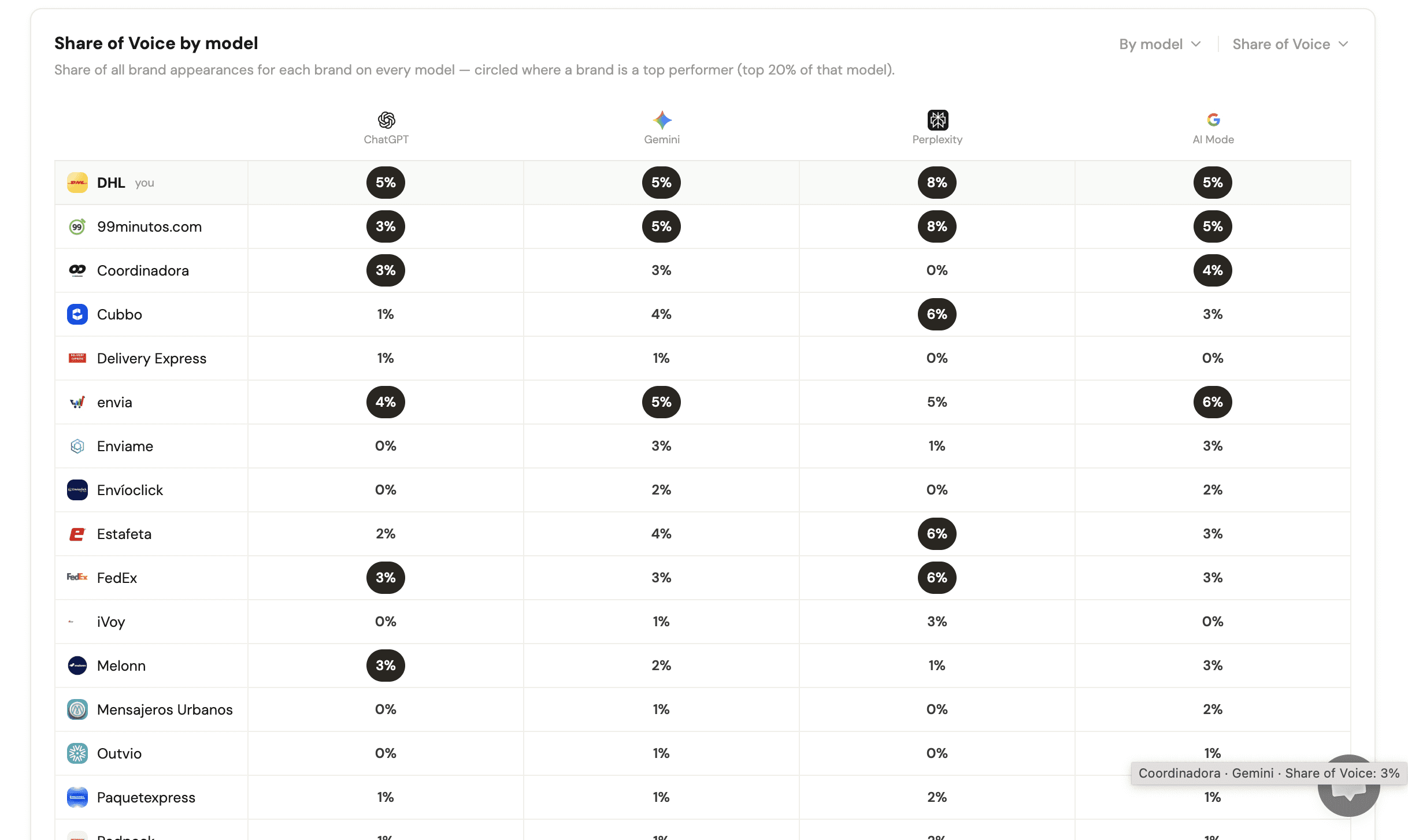
Measure GEO performance over time
If your team is investing in Generative Engine Optimization, digital PR, content, comparison pages, third-party coverage or technical improvements, you need a way to evaluate whether those efforts are changing how AI systems represent your brand.
Monitoring Share of Voice over time gives you a competitive benchmark.
Identify emerging competitors
The companies AI recommends are not always the competitors already sitting inside your marketing spreadsheet.
AI systems may repeatedly surface newer platforms, niche providers or alternative solutions that your team hasn't considered major competitors.
Tracking the actual brands appearing in AI responses helps reveal who is competing with you for attention.
AI Share of Voice vs. AI Visibility
These two metrics are related, but they answer different questions.
AI Visibility asks:
How often does my brand appear?
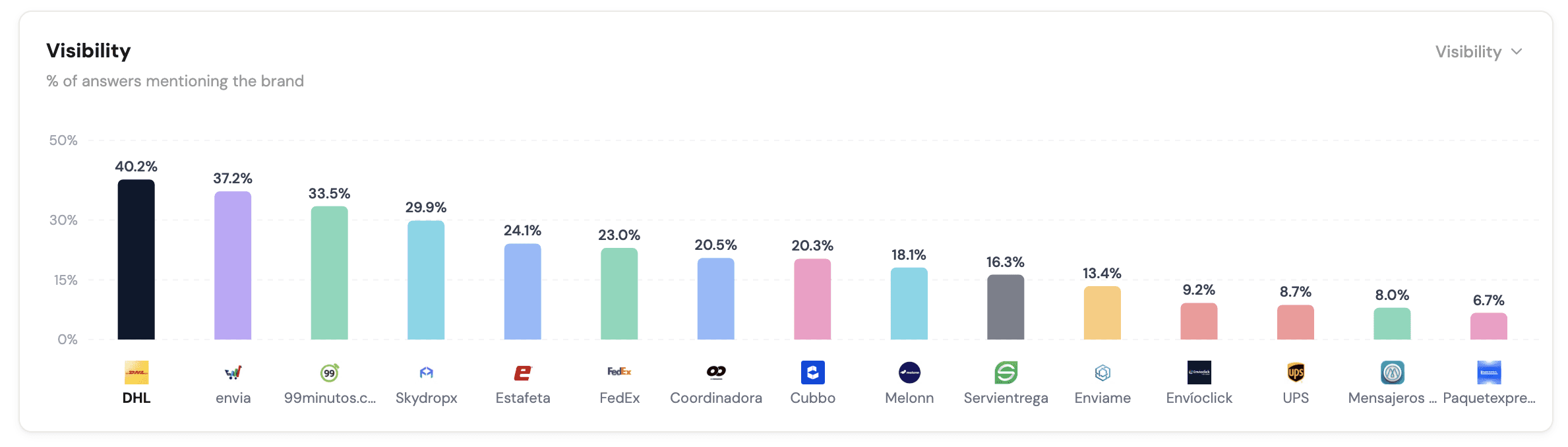
AI Share of Voice asks:
How much of the competitive brand conversation belongs to my company?
For example, imagine your brand appears in 60% of monitored AI responses.
That sounds strong.
But if each answer contains eight or ten competitors, you may still capture a relatively small portion of the total Share of Voice.
Another brand could appear in fewer responses but consistently rank among the first two recommendations.
That creates a very different competitive position.
This is why Share of Voice should be analyzed together with other AI visibility metrics.
Metric | What it tells you |
|---|---|
Visibility | How frequently your brand appears |
Share of Voice | Your portion of total brand appearances |
Position | Where your company appears relative to competitors |
Top 3 Rate | How often you're among the first three brands mentioned |
Citations | Which pages or domains AI uses as sources |
Citation Share of Voice | How much cited authority belongs to your brand |
Sentiment | Whether AI describes your brand positively, neutrally or negatively |
Together, these metrics provide a much clearer picture than mentions alone.
How to Measure AI Share of Voice With Oppin
Oppin monitors the prompts that matter to your business across leading AI platforms and analyzes the answers for brand mentions, competitors, citations, positioning and other signals.
Here's how to set up Share of Voice tracking.
1. Identify the prompts your brand should appear in
The quality of your measurement starts with the prompts you monitor.
The goal is not to track random questions.
You want to monitor the conversations where your company should realistically be considered.
Ask yourself:
What would a potential customer ask an AI assistant before discovering or choosing a company like ours?
For a CRM platform, that could include:
What are the best CRM platforms for startups?
Which CRM is best for small sales teams?
What are the easiest CRM platforms to use?
Which CRM platforms are affordable for small businesses?
What CRM works best for B2B SaaS?
What are the best CRM platforms with automation?
Notice that these are primarily non-branded prompts.
That's important.
If you only ask questions containing your company's name, you're mainly measuring whether AI knows information about your brand.
To measure competitive discovery, you also need prompts where AI has to decide which companies deserve to be recommended.
2. Organize prompts by topic
Avoid treating your entire market as one category.
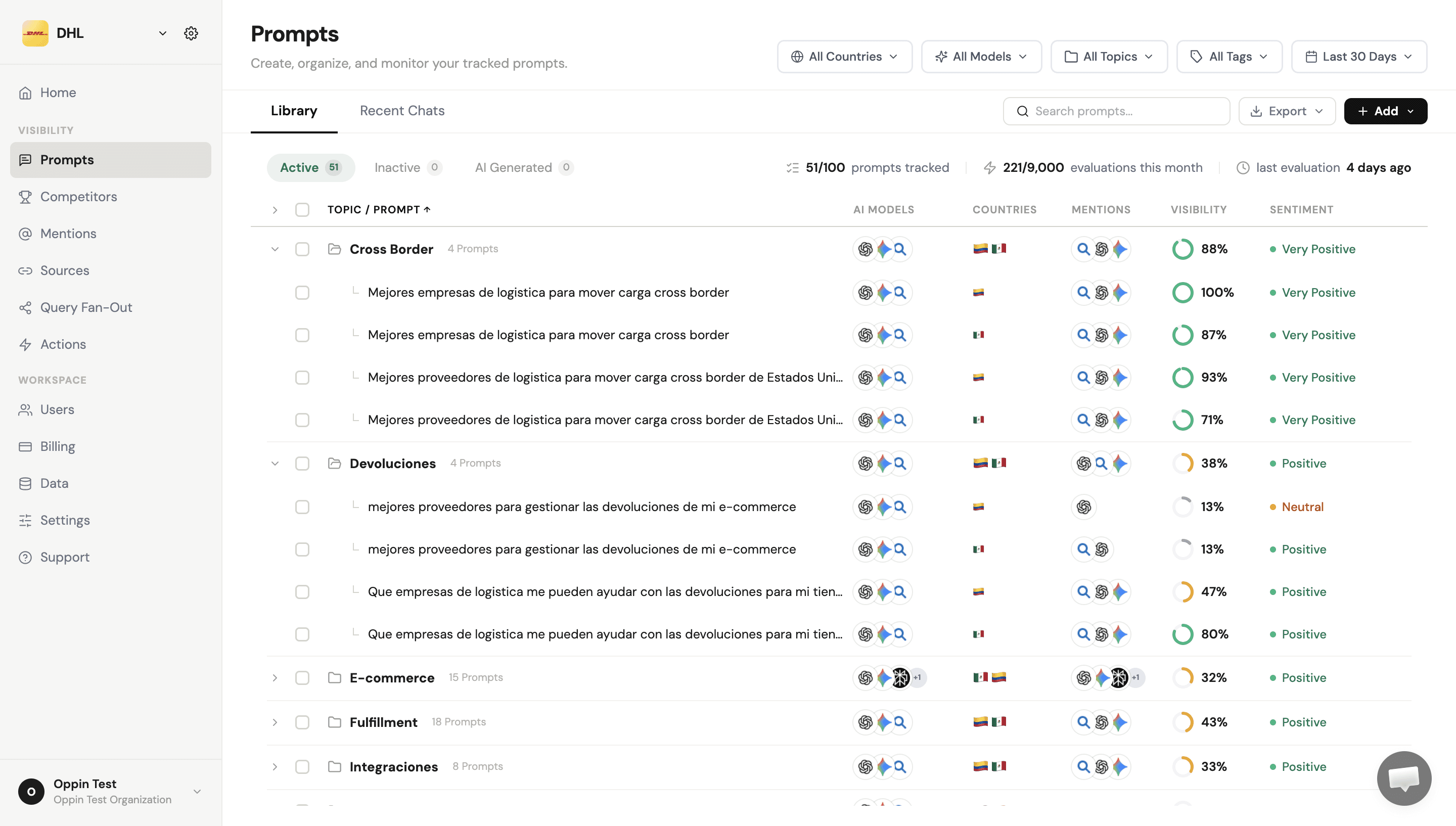
Organize prompts around meaningful themes such as:
Product category
Features
Pricing
Integrations
Industries
Use cases
Customer segments
Alternatives
Geographic markets
This allows you to uncover patterns that an overall Share of Voice score might hide.
For example, your total SoV could be 24%.
But when you break it down by topic, you might discover:
Integrations: 41%
SMB use cases: 33%
Enterprise: 11%
Pricing: 8%
That immediately tells you where the largest visibility gaps exist.
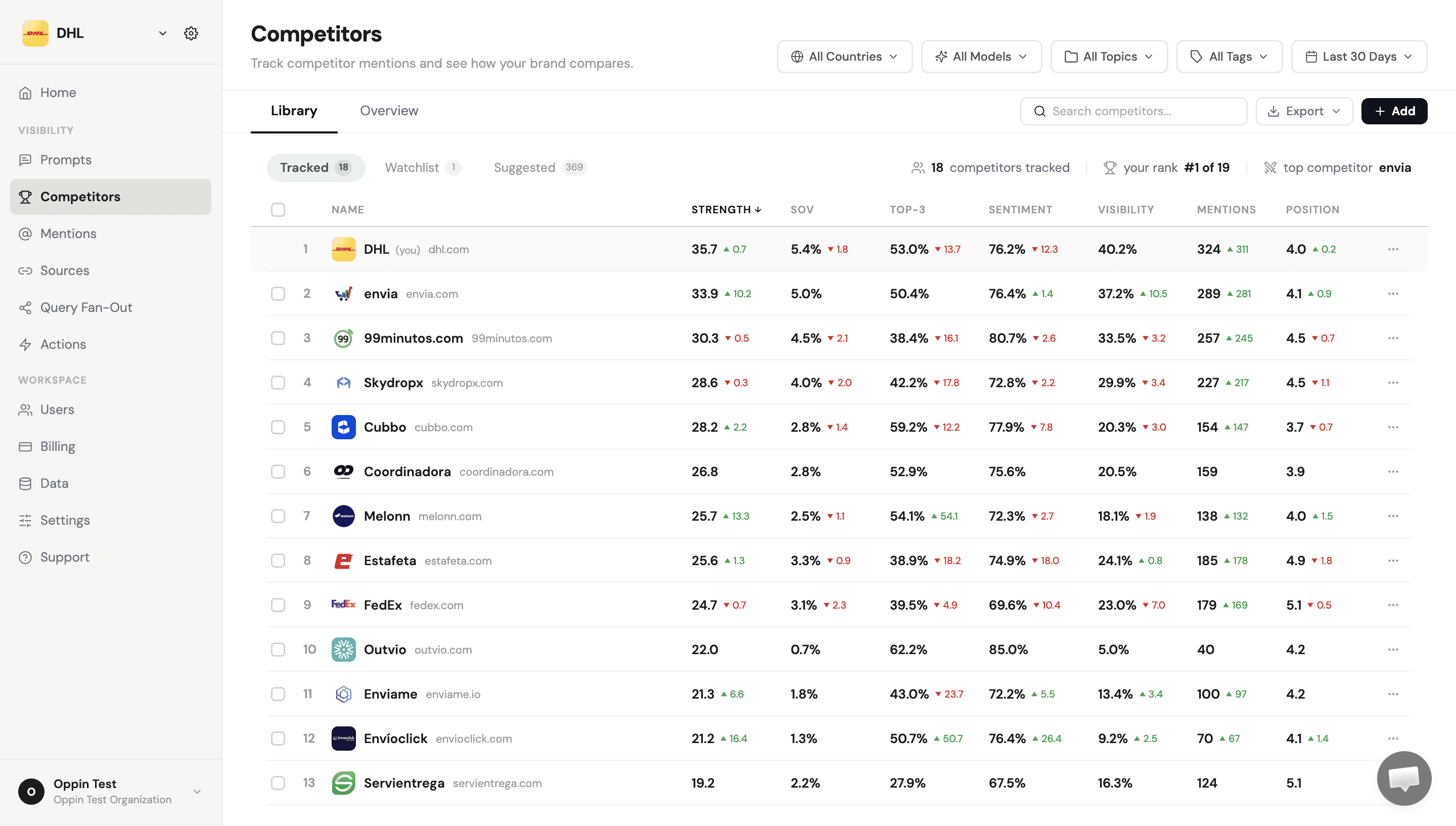
3. Monitor the right competitors
Add the companies you already consider your main competitors.
But don't stop there.
Pay attention to other brands that repeatedly appear across your tracked AI answers.
One of the useful aspects of AI visibility monitoring is that it can reveal the competitive landscape AI systems themselves are creating.
You may find companies competing for the same recommendations even if you don't normally consider them direct competitors.
4. Collect responses across multiple AI platforms
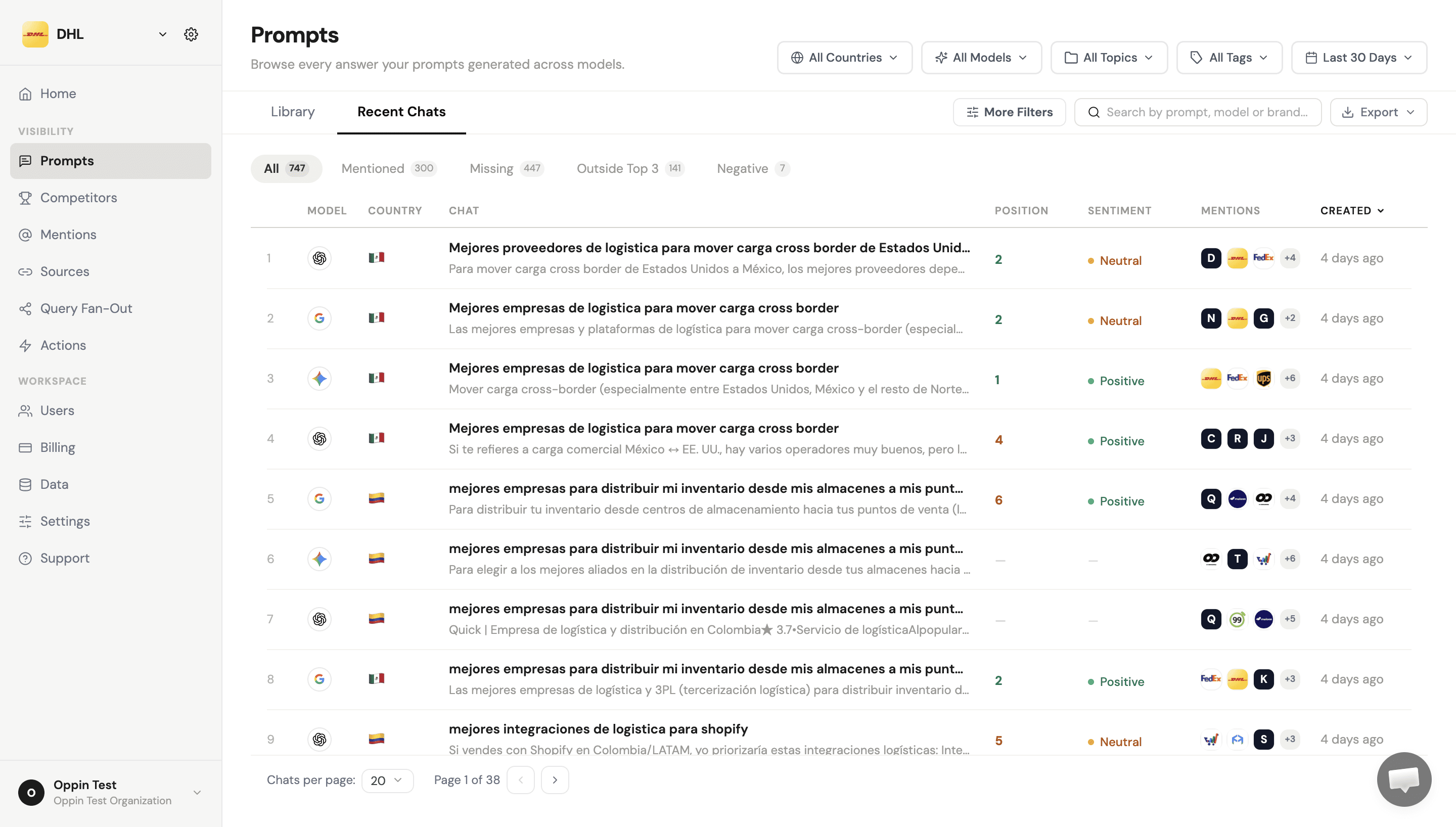
AI visibility varies significantly from one platform to another.
Your brand could perform well in ChatGPT and poorly in Gemini.
Or you could be visible in Perplexity while rarely appearing in Google AI results.
Running the same prompt once manually doesn't give you enough information to understand those differences.
Oppin allows you to monitor prompts continuously across supported AI platforms so you can analyze a consistent dataset over time.
This matters because AI-generated answers are non-deterministic.
The same question can produce different recommendations across models and even across separate runs.
Instead of making decisions from isolated answers, you can evaluate broader trends.
5. Check your Share of Voice
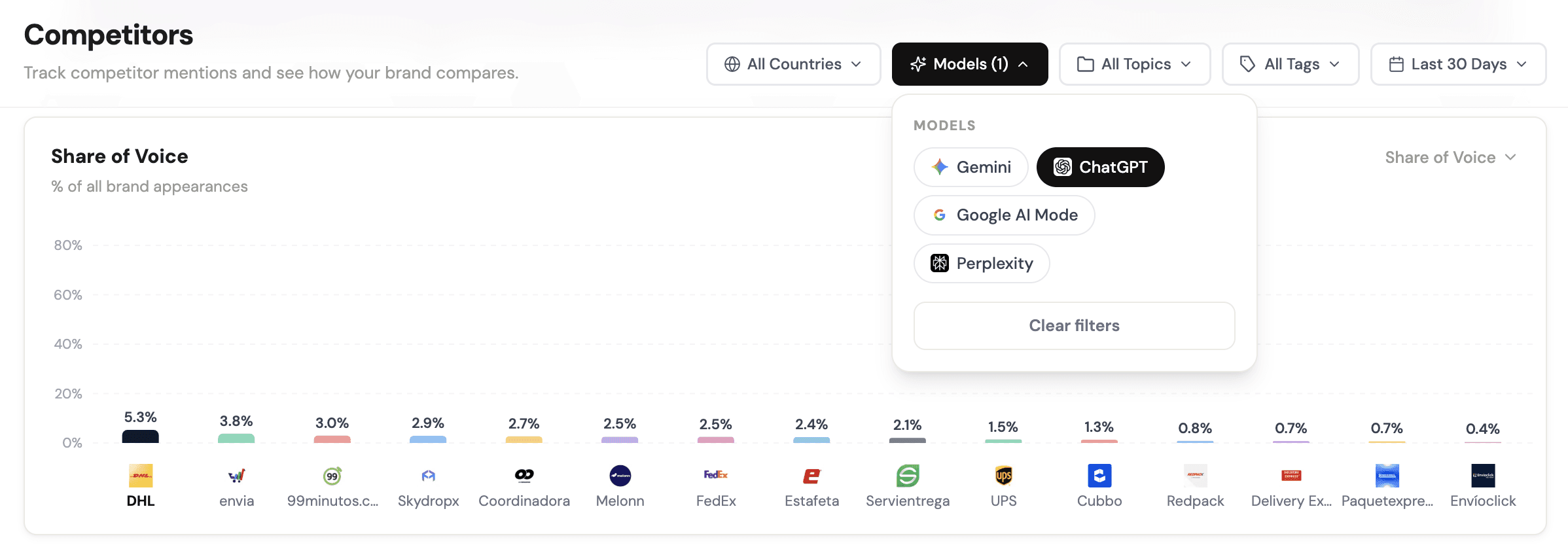
Once Oppin begins collecting responses, you can compare your brand against competitors.
Your Share of Voice view helps answer questions such as:
What percentage of the conversation do we currently own?
Which competitor has the highest Share of Voice?
How large is the gap between us and the category leader?
Are we gaining or losing ground?
Which brands are appearing more frequently over time?
Instead of asking:
“How many times did AI mention us?”
you can ask:
“How competitive is our brand inside AI recommendations?”
That's a much more useful business question.
6. Segment the data
Your overall Share of Voice is only the starting point.
Break your performance down by:
AI model
Country
Language
Topic
Time period
For example, your total AI Share of Voice might be 18%.
But the platform-level data could look like:
ChatGPT: 31%
Perplexity: 25%
Gemini: 12%
Google AI: 7%
The average tells you that you have a problem.
The breakdown tells you where the problem is.
The same principle applies geographically.
If you operate internationally, your brand might dominate AI recommendations in one market while remaining almost invisible in another.
7. Find the prompts you're losing
Once you identify an underperforming area, examine the individual prompts.
Look for situations where:
Competitors appear and your brand doesn't
Your brand is mentioned below several competitors
Competitors consistently receive stronger recommendations
Your company appears inconsistently
Certain use cases rarely produce a mention
AI cites third-party sources that include competitors but exclude you
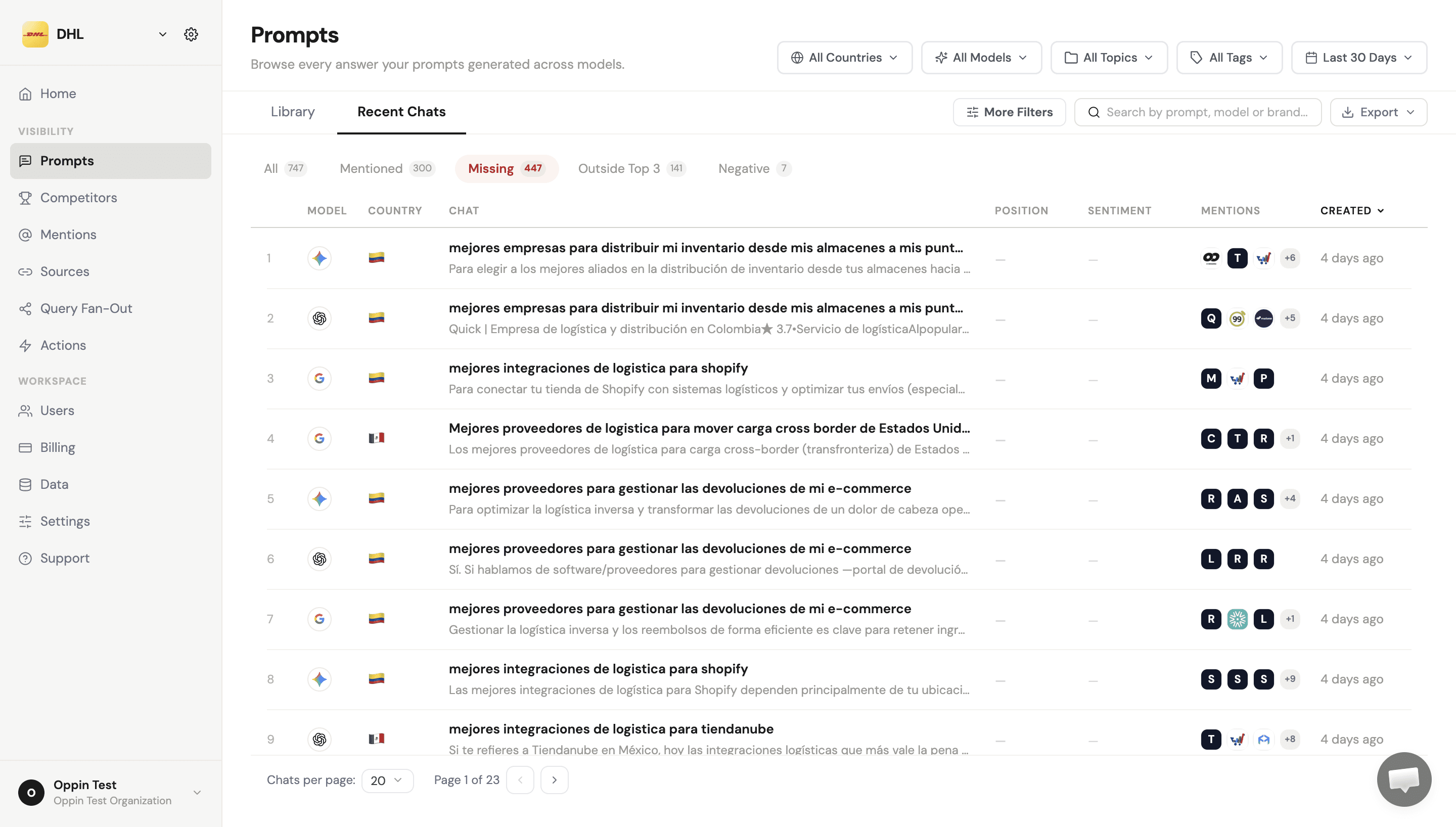
This is where Share of Voice becomes actionable.
The percentage tells you that a competitive gap exists.
The underlying responses can help explain why it exists.
How to Interpret Your AI Share of Voice
There is no universal “good” AI Share of Voice.
A 15% Share of Voice could make you the market leader in a highly fragmented category.
The same 15% could mean you're significantly behind a competitor that owns 50%.
Instead of chasing an arbitrary benchmark, compare three things:
1. Your Share of Voice relative to competitors
Are you leading, following closely or significantly behind?
2. Your trend over time
Are you gaining or losing competitive visibility?
3. Your performance across important segments
Which topics, markets and AI models are strongest or weakest?
It's also helpful to compare Share of Voice with Visibility.
Visibility | Share of Voice | Possible interpretation |
|---|---|---|
High | High | Strong coverage and competitive presence |
High | Low | You appear often, but many competitors appear with you |
Low | High | You perform strongly in a limited group of conversations |
Low | Low | You have both a coverage and competitive visibility problem |
This helps determine which on-site and off-site GEO actions should come next.
How to Improve AI Share of Voice
If your Share of Voice is low, don't immediately start publishing more content.
First determine why competitors are winning.
Find missing-topic opportunities
Look for clusters of prompts where your competitors appear repeatedly and your brand is absent.
If those prompts share the same underlying intent, you may have a topical gap.
For example, AI may recognize your product as a strong general solution but fail to associate it with:
A specific industry
A particular feature
Enterprise customers
Small businesses
A geographic market
A specific integration
You may need to strengthen that connection through product pages, use-case content, documentation, FAQs or external coverage.
Analyze the sources influencing AI answers
Your own website is only one part of AI visibility.
AI systems can rely on:
Industry publications
Review websites
Comparison pages
Product directories
Forums
Reddit
YouTube
News coverage
Documentation
Other third-party sources
If influential pages repeatedly recommend competitors but never mention your company, that may be one of the reasons your Share of Voice is lower.
Oppin's Sources analysis can help identify the domains and pages that frequently appear in the AI responses you're monitoring.
That gives you a more focused approach to digital PR, outreach and content distribution.
Instead of trying to earn mentions everywhere, you can prioritize the sources already influencing the conversations you care about.
Analyze Query Fan-Out
AI systems don't always answer a question based on the exact wording of the user's prompt.
They may expand the original request into several related searches before generating an answer.
A question like:
“What is the best CRM for startups?”
could lead to research around:
Affordable CRM software
CRM for small sales teams
Startup CRM comparisons
Easy-to-use CRM platforms
CRM pricing
CRM implementation
Oppin's Query Fan-Out analysis can help uncover these underlying searches.
That creates another layer of opportunity.
You aren't only optimizing for the original question.
You're learning which related topics may influence the final recommendation.
Improve your position, not only your mentions
Visibility alone doesn't guarantee strong influence.
If your brand appears in many answers but regularly sits behind four competitors, you're technically visible but not necessarily prominent.
Look at:
Which companies consistently rank ahead of you
What sources support those recommendations
How competitors are described
Which attributes AI repeatedly associates with them
What evidence is missing around your own brand
The objective should eventually move from:
“Get mentioned.”
to:
“Become one of the first brands AI recommends.”
How Often Should You Measure AI Share of Voice?
AI visibility should be monitored continuously, but you shouldn't overreact to daily fluctuations.
Generative AI answers naturally vary.
A practical approach is:
Daily: Collect enough responses to build reliable historical data.
Weekly: Review changes in competitors, prompts and major visibility gaps.
Monthly: Evaluate Share of Voice trends and measure whether your GEO initiatives are producing meaningful improvements.
The longer your tracking history, the easier it becomes to distinguish temporary answer variation from genuine competitive movement.
Common AI Share of Voice Mistakes
Tracking only branded prompts
Branded questions are useful for understanding brand perception, but they don't accurately measure competitive discovery.
Include non-branded prompts where AI has to choose between different companies.
Tracking too few topics
Ten variations of the same question won't provide a reliable picture of your category.
Monitor the different problems, features and use cases that influence buying decisions.
Treating every AI platform the same
Different AI platforms can produce very different recommendations.
Always analyze performance at the model level.
Making decisions based on one answer
Generative AI is variable.
Look at repeated observations across a meaningful sample rather than individual responses.
Focusing only on mentions
A mention does not tell you whether you're the first recommendation, the fifth option or an afterthought.
Combine Share of Voice with Position, Top 3 Rate and other relevant metrics.
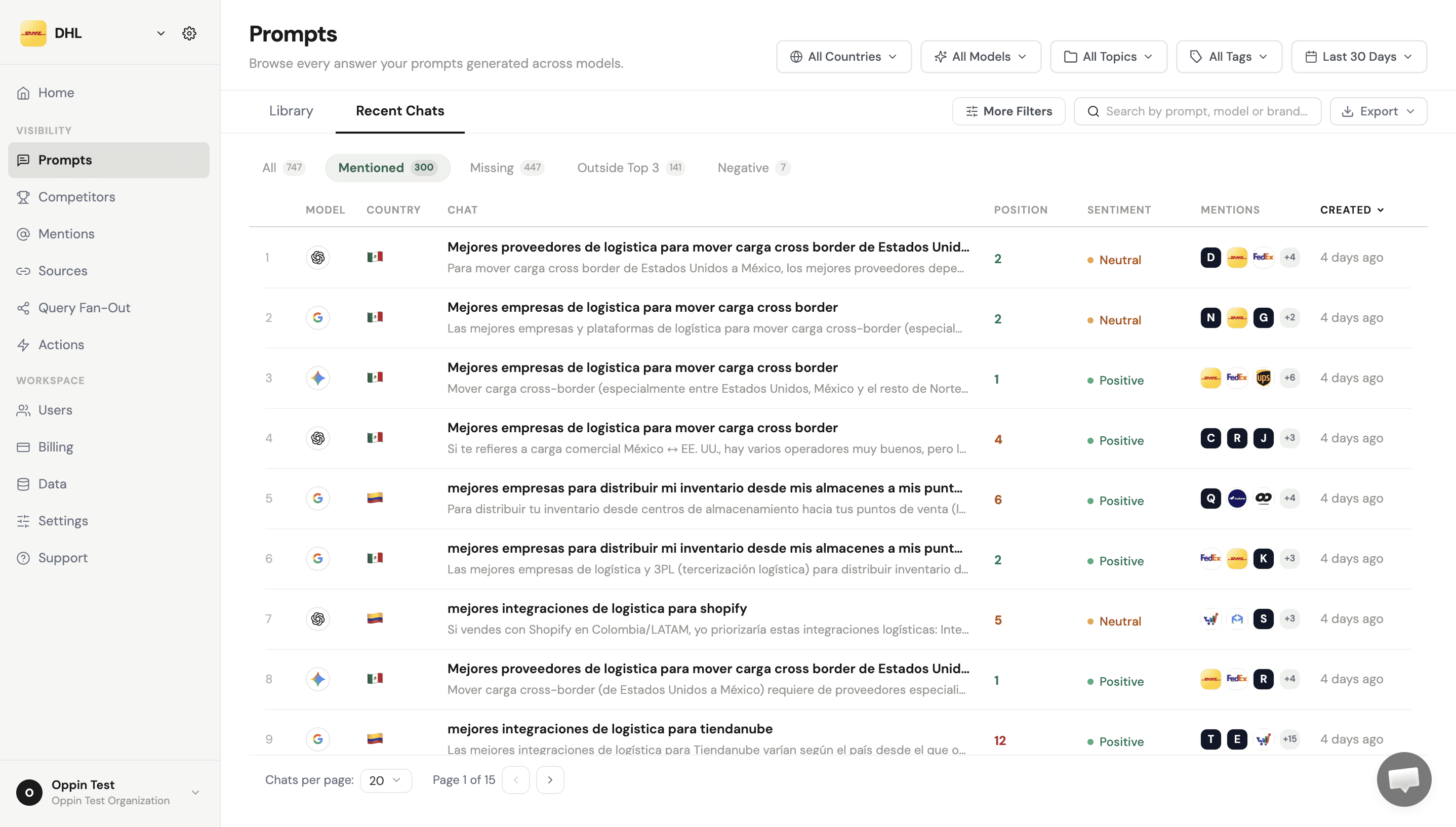
AI Share of Voice Turns AI Visibility Into Competitive Intelligence
Knowing that AI mentions your company is useful.
Knowing how frequently it mentions you compared with everyone else is much more valuable.
AI Share of Voice gives marketing teams a competitive view of brand visibility across ChatGPT, Gemini, Perplexity, Google AI and other AI platforms.
With Oppin, you can go beyond the headline percentage and understand:
Which competitors are winning
Which topics you're losing
Where your strongest markets are
Which AI platforms favor your brand
What sources influence recommendations
Which underlying searches may be shaping the final answers
That changes AI visibility from a reporting exercise into something marketers can act on.
Because the most important question isn't simply:
“Does AI know our brand?”
It's:
“When someone asks AI for the best companies in our market, how often are we part of the answer?”
Frequently Asked Questions
What is AI Share of Voice?
AI Share of Voice measures your brand's portion of total brand appearances across AI-generated answers. It helps compare your presence in AI recommendations with the companies competing for the same conversations.
How do you calculate AI Share of Voice?
Oppin calculates it using:
AI Share of Voice = (Answers mentioning your brand ÷ Total brand appearances) × 100
Each brand is counted once per answer.
What is the difference between AI Visibility and AI Share of Voice?
AI Visibility measures how frequently your brand appears across monitored responses.
AI Share of Voice measures how much of the total competitive brand conversation belongs to your company.
Can you measure Share of Voice in ChatGPT?
Yes. By monitoring a consistent group of prompts and tracking which brands appear in the responses, you can measure your Share of Voice in ChatGPT and compare it with other AI platforms.
What is a good AI Share of Voice?
There is no universal benchmark. The most useful comparison is against your direct competitors, your historical performance and your visibility across important topics and markets.
How can I improve my AI Share of Voice?
Start by identifying prompts where competitors appear and your brand doesn't. Then analyze content gaps, influential sources, Query Fan-Out opportunities and how competitors are positioned within the answers.
How often should AI Share of Voice be tracked?
Responses can be collected daily, while strategic performance is better evaluated weekly and monthly. Longer-term trends are more reliable than individual AI responses.
Start tracking your AI Share of Voice with Oppin and see how your brand compares with competitors across the leading AI search platforms.
Related Articles
Want to explore other AI visibility platforms and see how they compare?
Oppin vs Profound: Compare both platforms across AI search tracking, competitive intelligence and optimization workflows.
Oppin vs Peec AI: Explore the differences between Oppin and Peec AI for monitoring brand visibility across AI platforms.