How to track your brand visibility in AI Search with Oppin

Ricardo Matos
How to guides

TL;DR: AI search visibility cannot be measured with traditional SEO rankings alone. To understand how your brand performs in ChatGPT, Gemini, Google AI, Perplexity, Grok, Copilot, and other AI search experiences, you need to track the prompts that matter to your business, monitor how often your brand appears, measure its position and Share of Voice, analyze sentiment and sources, benchmark competitors, and understand the searches AI models run behind the scenes. Oppin brings these signals together in one AI search visibility platform and turns the data into prioritized on-site and off-site actions.
AI search is changing how people discover products, services, and brands.
Instead of searching Google, opening several websites, comparing options, and making a decision, a potential customer can ask ChatGPT or Gemini:
“What are the best CRM platforms for a small sales team?”
The answer may contain only a handful of companies.
If your brand is included, you are part of the consideration set. If competitors appear instead, your website may never get the opportunity to influence that decision.
This creates a new challenge for SEO, marketing, and growth teams:
How do you measure whether your brand is actually visible in AI search?
Traditional SEO platforms can tell you where a page ranks for a keyword. They cannot fully tell you how an AI model recommends your brand, which competitors appear alongside you, what sources influence the answer, or how your brand is positioned inside the response.
That is where AI search visibility tracking comes in.
What is AI search visibility?
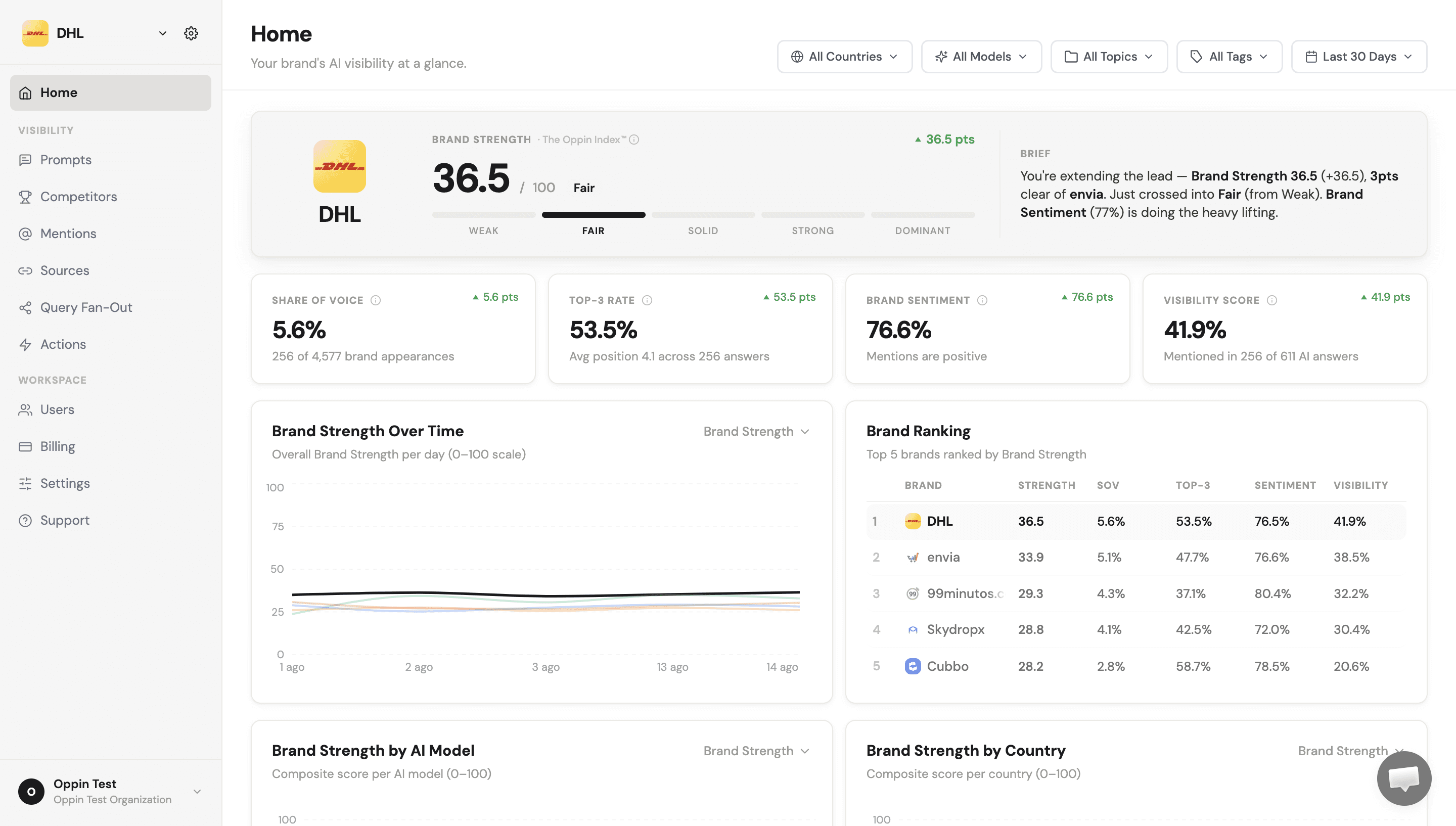
AI search visibility measures how frequently and prominently your brand appears in answers generated by AI search platforms.
The concept is similar to search visibility in SEO, but the environment is fundamentally different.
AI models generate answers dynamically. Results can vary between runs, different platforms can produce different recommendations, and models may consult external sources before responding.
Oppin addresses this by running the prompts you define directly across supported AI platforms and analyzing the resulting answers.
The goal is not simply to answer:
“Did the AI mention my brand?”
A useful AI visibility measurement system should help you answer:
How often is my brand mentioned?
Where does my brand appear compared with competitors?
Which competitors are winning?
What is my Share of Voice?
Is the AI describing my brand positively?
Which websites are influencing the answers?
Which sources are being cited?
What searches are happening behind the original prompt?
Which AI platforms perform best for my brand?
What should I do to improve my visibility?
Why traditional SEO tools are not enough?
AI search introduces a different layer between a user's question and a brand's visibility.
In traditional search, you can track a keyword, ranking position, page, and search engine.
In AI search, the same user intent can produce an answer containing multiple brands, supporting explanations, sources, citations, and additional searches performed by the model.
This means that a single ranking position does not tell the whole story.
For example, imagine you sell project management software and someone asks:
“What are the best project management tools for remote teams?”
An AI answer could mention:
Brand A
Brand B
Your brand
Brand C
It could also describe your product positively, cite a third-party review, and use information from several websites before producing the answer.
A traditional SEO report might show that your website ranks well for “project management software.”
It would not necessarily tell you that Brand A is consistently recommended ahead of you by AI models.
AI visibility tracking fills that gap.
How to track your brand visibility in AI search
A practical AI search visibility strategy can be broken down into several steps.
1. Define the prompts that matter to your business
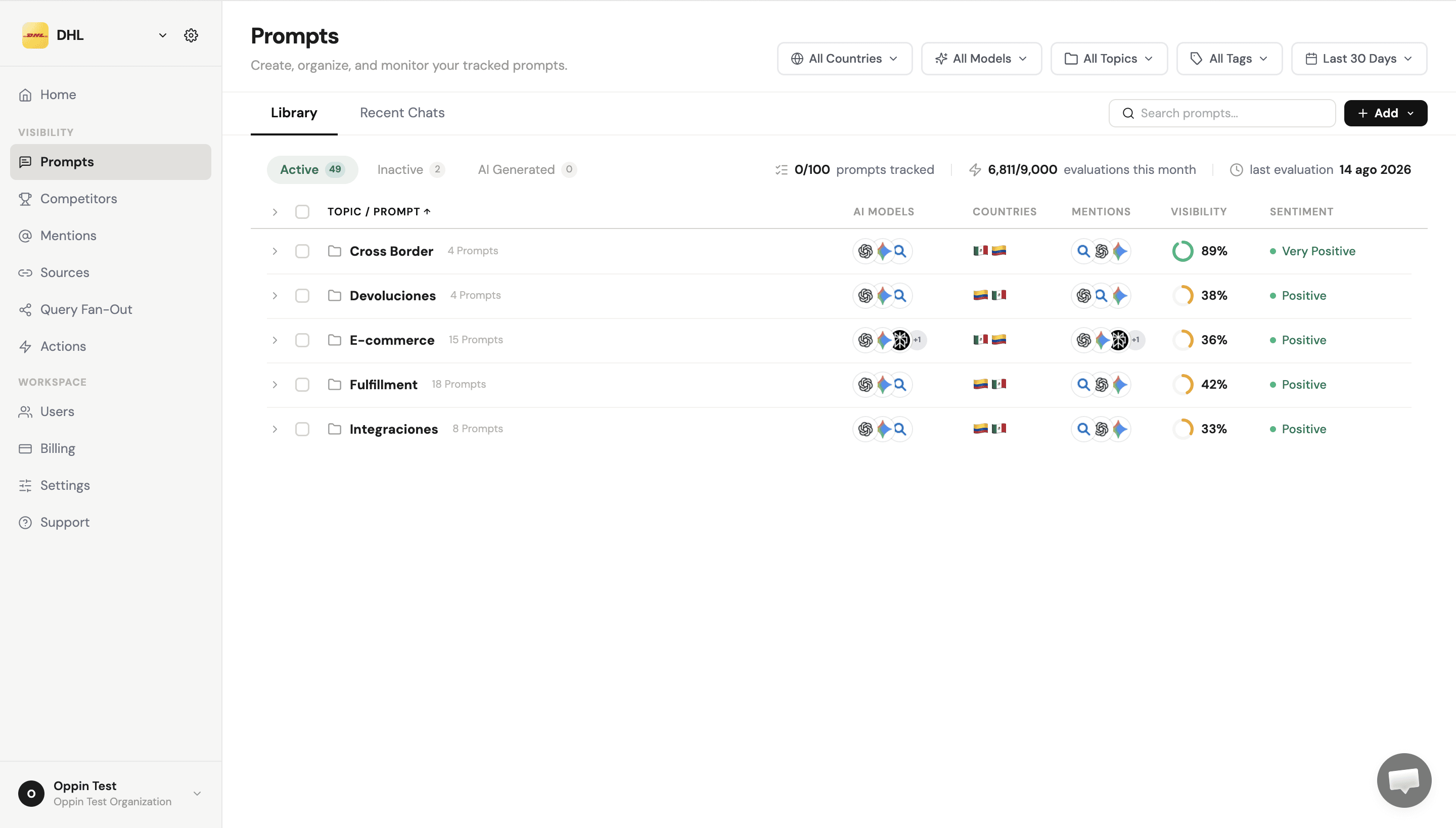
The first step is identifying the questions you want your brand to be the answer to.
Instead of thinking only in keywords, think in terms of real questions and buying decisions.
For example, a cybersecurity company could track:
What are the best cybersecurity platforms for startups?
What should a 50-person company look for in cybersecurity software?
What are the best alternatives to [competitor]?
Which cybersecurity tools offer the best endpoint protection?
What cybersecurity companies are best for small businesses?
These prompts represent different stages and types of search intent.
You can organize related prompts into topics to make the resulting data easier to analyze.
Oppin supports three ways to add prompts: AI generation, manual creation, and file import.
The quality of your prompt set matters because your visibility metrics are only meaningful in the context of the questions you are tracking.
2. Track the prompts across multiple AI platforms
AI search is not one search engine.
Different platforms can produce different answers to the same question.
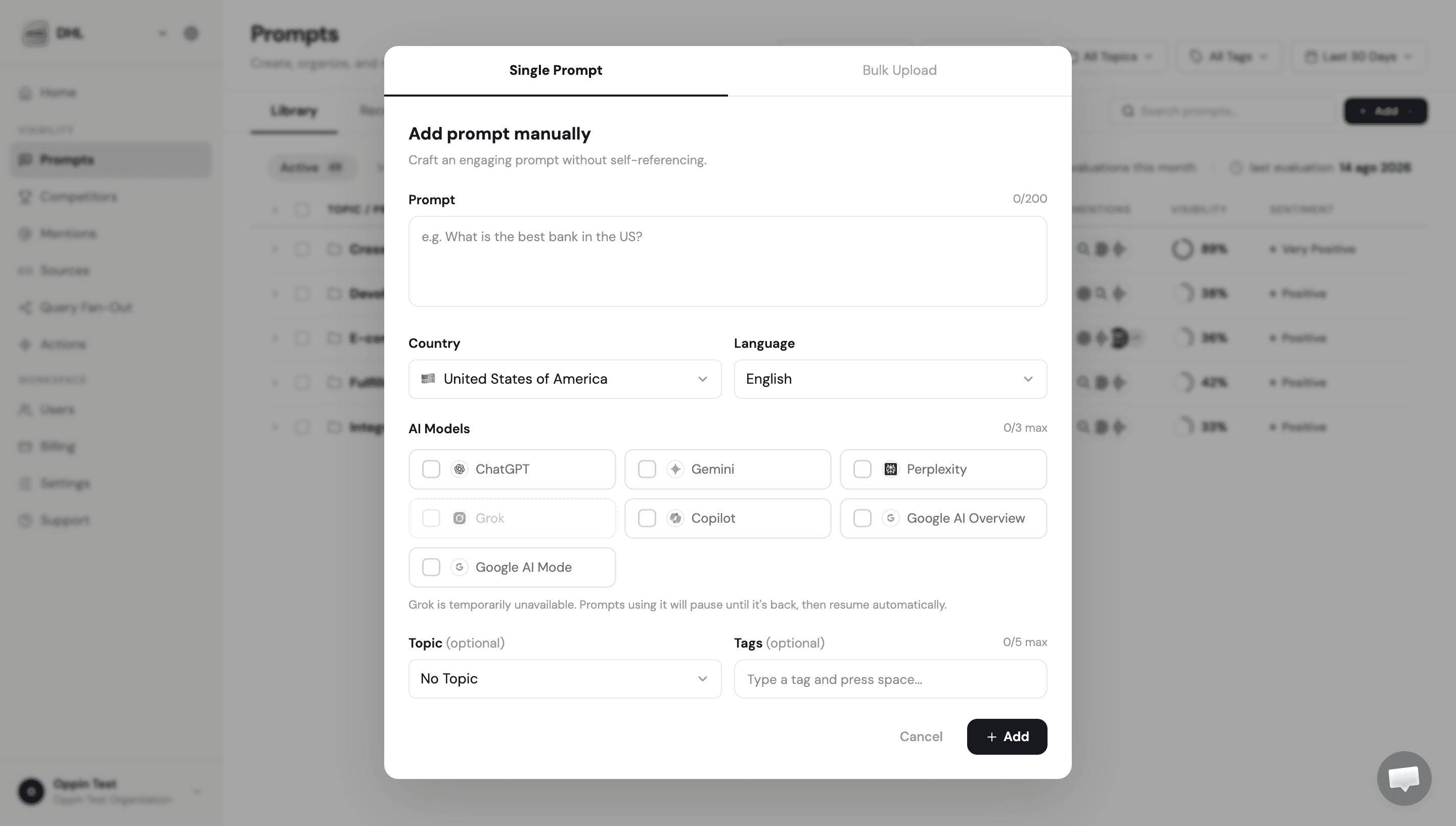
Oppin currently tracks seven AI platforms:
ChatGPT
Gemini
Perplexity
Grok
Microsoft Copilot
Google AI Overview
Google AI Mode
This multi-platform approach is important because a brand can perform strongly on one platform while having limited visibility on another.
For example, you might discover that your brand is frequently recommended by Gemini but rarely appears in ChatGPT answers.
Without cross-platform tracking, that difference can remain hidden.
Oppin runs your selected prompts daily and captures the resulting AI answers so you can monitor changes over time.
3. Establish your AI visibility baseline
Before trying to improve your AI presence, establish where your brand stands today.
Oppin measures several core metrics that provide different views of your performance.
Visibility
Visibility measures the percentage of tracked AI responses that mention your brand.
If your brand appears in 30 out of 100 relevant responses, your visibility would be 30%.
This gives you a straightforward answer to:
“How often is AI mentioning my brand?”
Visibility is useful as a baseline because you can track whether your presence increases or decreases as your GEO strategy evolves.
Share of Voice
Visibility tells you whether you appear.
Share of Voice tells you how much of the conversation belongs to you compared with other brands.
Oppin calculates Share of Voice based on the brand mentions found across tracked AI answers.
For example, an AI response might mention five companies. If your brand receives a significant portion of the mentions across your tracked answers, your Share of Voice will increase.
This makes the metric particularly useful for competitive benchmarking.
Position
Being mentioned is not the same as being recommended first.
Position measures where your brand appears within AI answers.
Oppin also tracks Top 3 Rate, which measures how frequently your brand appears among the first three positions. Top 3 Rate contributes to the overall Brand Strength score.
This distinction matters because a brand consistently appearing first is generally in a stronger competitive position than one that is mentioned at the end of an answer.
Sentiment
AI visibility is not only about frequency.
You also need to understand how AI models describe your brand.
A brand can have strong visibility while being associated with negative or unfavorable language.
Oppin measures sentiment on a 0 to 100 scale, helping you understand how favorably AI models talk about your brand.
This can reveal issues that a simple mention count would miss.
4. Use a composite metric to understand overall performance
Looking at individual metrics is useful, but teams also need a high-level way to understand their overall AI search performance.
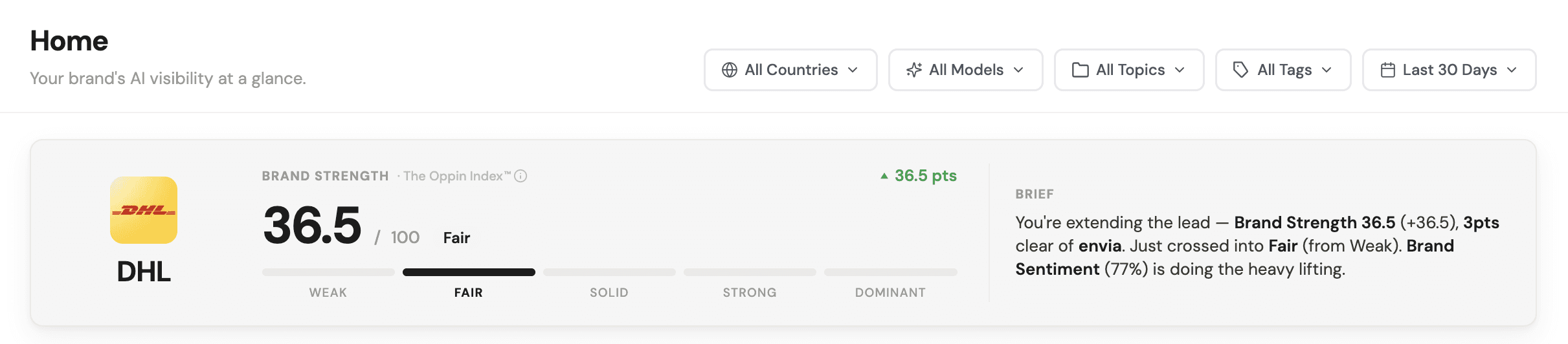
Oppin's Brand Strength score combines four signals:
Share of Voice
Top 3 Rate
Visibility
Sentiment
The result is a score from 0 to 100 that provides a broader view of your brand's AI search performance.
Think of Brand Strength as your AI search health indicator.
The individual metrics explain why the score is moving.
For example:
Visibility may be increasing.
Share of Voice may be declining because competitors are growing faster.
Sentiment may be improving.
Top 3 Rate may remain flat.
Together, these metrics provide much more context than a single mention count.
5. Benchmark your competitors
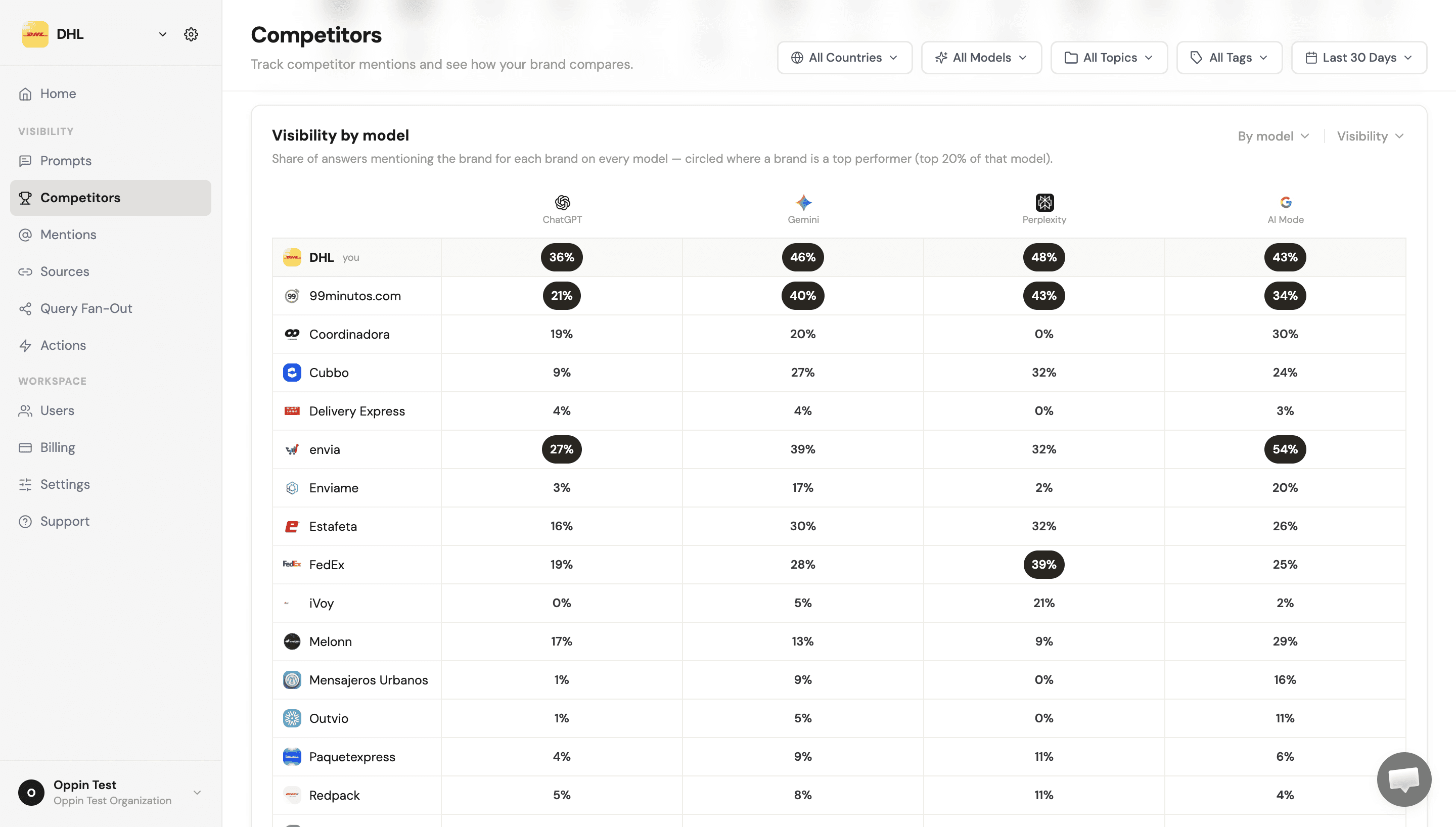
AI search is competitive.
You are not simply trying to increase your own visibility. You are competing for the limited number of brands that AI models recommend in their answers.
That makes competitor tracking essential.
Oppin lets you add competitors and monitor their performance alongside your own brand. It can also surface competitors that you did not initially think to track.
This can uncover important patterns.
For example:
Your brand: 35% visibility
Competitor A: 52% visibility
Competitor B: 28% visibility
You may initially think that your 35% visibility is strong.
But the competitive context shows that Competitor A is significantly ahead.
You can then investigate the prompts and topics where that competitor consistently wins.
Look beyond your known competitors
One of the most useful aspects of AI search tracking is discovering brands you were not monitoring.
AI models may recommend unexpected alternatives, niche providers, publishers, marketplaces, or emerging companies.
Oppin's brand detection analyzes every brand that appears in tracked answers, while its suggested competitor functionality can surface additional competitors.
This gives you a more realistic view of the competitive landscape inside AI search.
6. Analyze the sources influencing AI answers
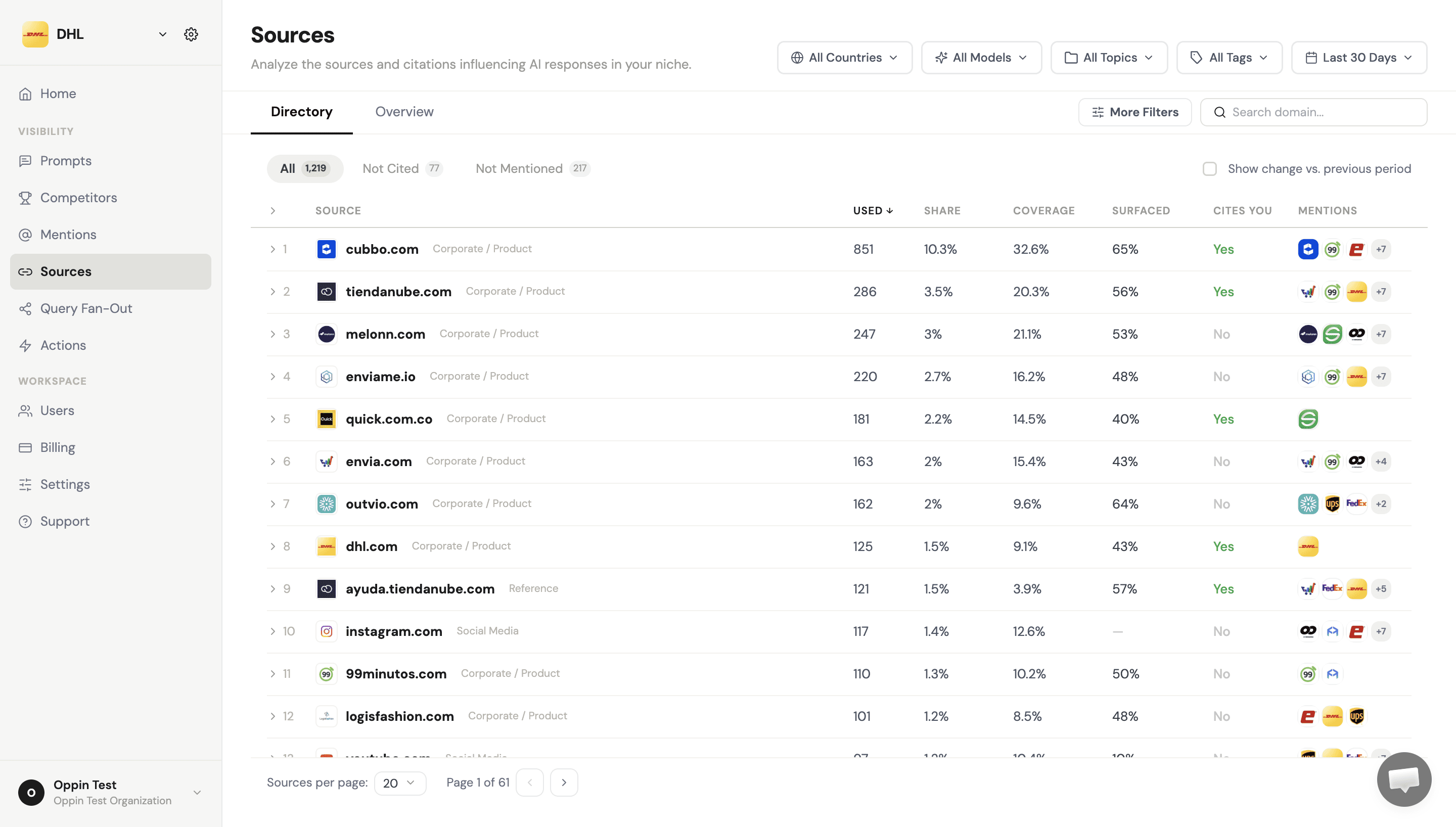
Knowing that your brand is missing from an AI answer is useful.
Knowing why it is missing is much more actionable.
AI models may consult websites before generating an answer. Those sources can influence what brands, products, and recommendations ultimately appear.
Oppin records the sources models consulted before answering and makes that information available through its Sources functionality.
This creates an important GEO workflow:
Find the sources influencing your target answers → identify the sites that repeatedly appear → understand what information they provide → build a strategy to earn relevant mentions and citations.
For example, you might discover that AI models frequently consult:
Industry publications
Review websites
Comparison articles
Directories
Reddit discussions
Your competitors' websites
Your own content
If competitors repeatedly appear on influential third-party websites while your brand does not, that can become an off-site GEO opportunity.
Sources vs. citations
Sources and citations are related, but they are not identical.
A source is a website or page that an AI model consulted while generating its answer.
A citation is a source that the model surfaces or links in the final response.
This distinction matters because a website can influence an AI answer without necessarily appearing as a visible citation.
Understanding both layers gives you a more complete picture of how AI systems form their answers.
7. Analyze the actual AI conversations
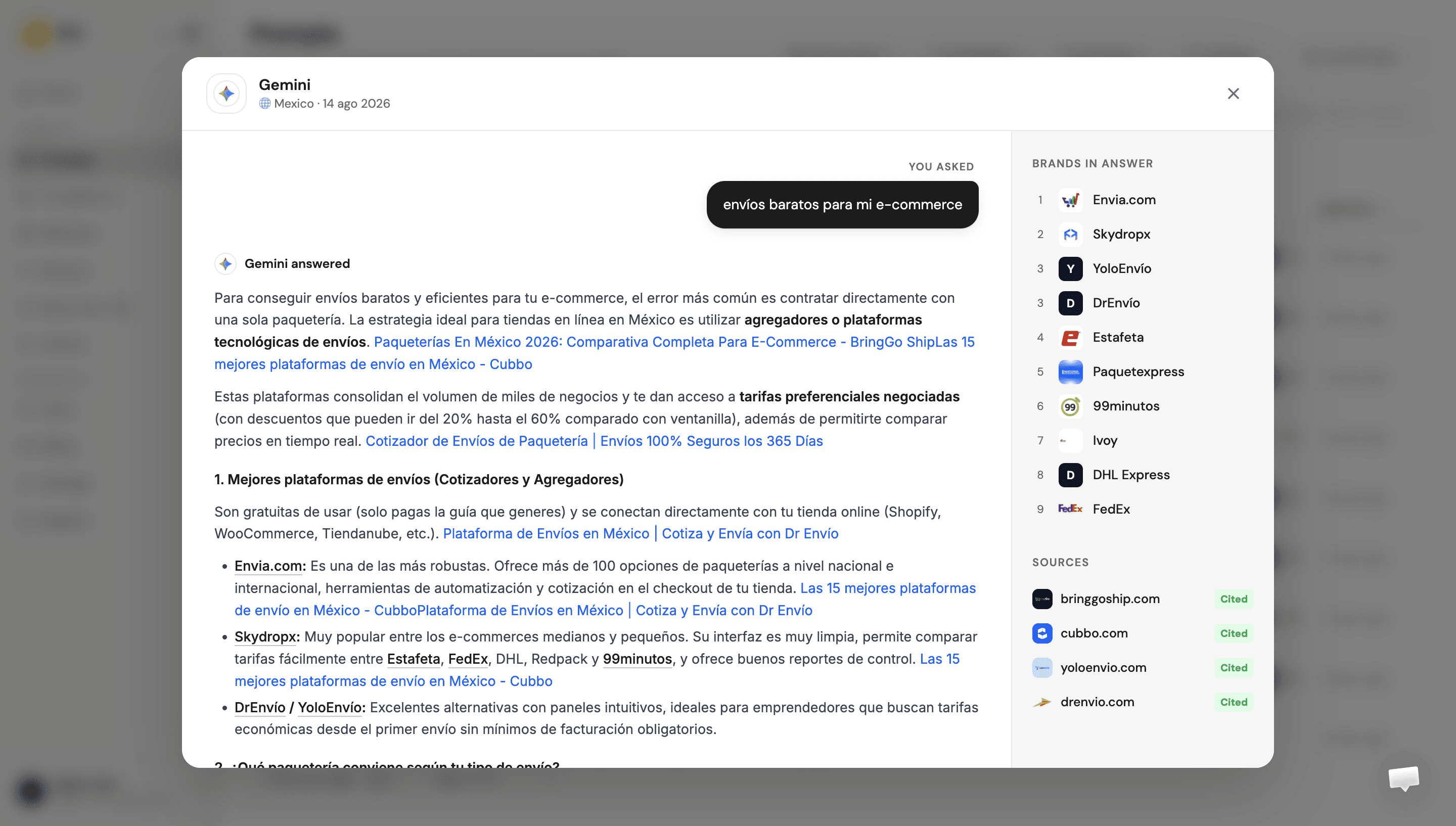
Aggregated metrics are useful, but you should always be able to go back to the underlying answers.
Every metric in Oppin traces back to individual captured chats: one prompt, one AI model, and one response.
This lets you inspect the actual language AI models use when discussing your brand.
Instead of seeing:
Visibility: 42%
you can investigate the responses behind that number.
You might discover that AI models describe your company as:
Affordable
Easy to use
Best for small businesses
But perhaps they never mention an important feature that differentiates your product.
That insight can directly influence your content and positioning strategy.
8. Understand Query Fan-Out
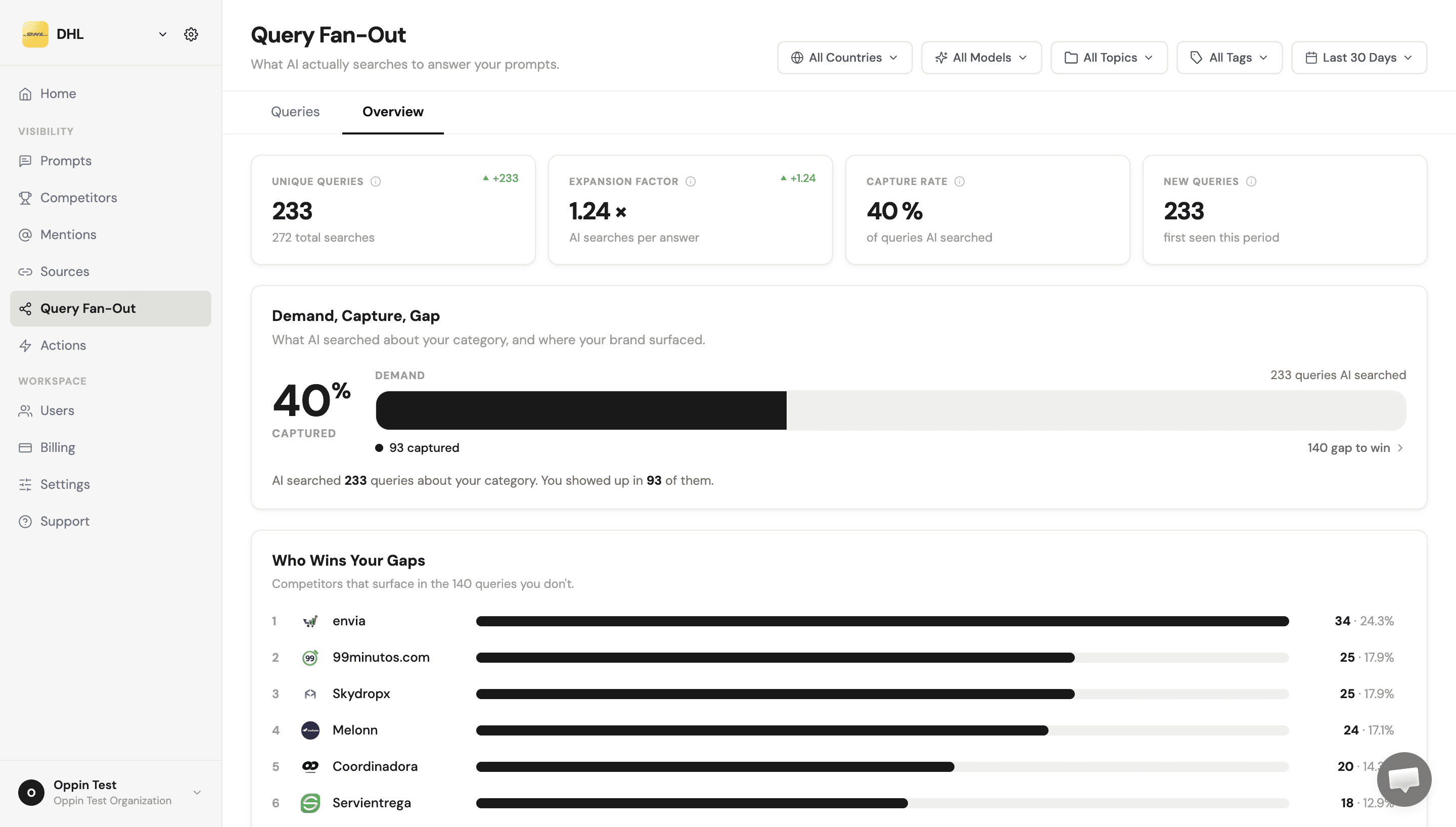
One of the biggest differences between traditional search and AI search is what happens behind the initial prompt.
When a user asks an AI model a question, the system may perform additional searches or break the original request into related queries before generating its answer.
This is known as query fan-out.
Consider the prompt:
“What is the best accounting software for a growing startup?”
The model may need to investigate several related questions:
Best accounting software for startups
Accounting software for growing companies
Startup accounting features
Accounting software pricing
Accounting software reviews
Alternatives to established accounting platforms
The final answer may be influenced by the information discovered across these related searches.
Oppin tracks these searches and shows the query fan-out associated with your prompts.
This creates another layer of GEO insight.
You are no longer optimizing only for the original question.
You can identify the related searches AI models use to construct their answers and determine whether your brand has a strong presence across those areas.
9. Measure how broadly your brand reaches across AI models
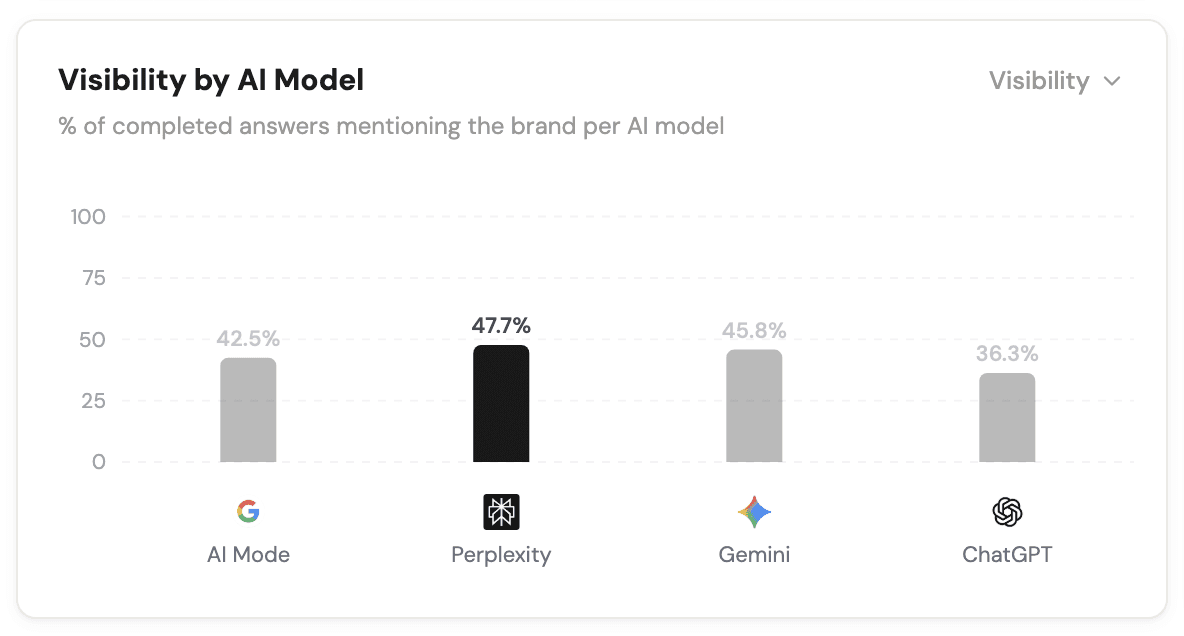
A brand may be highly visible on one AI platform but absent from others.
Oppin's Model Reach metric measures how many of the AI platforms that answer your tracked prompts mention your brand.
This helps answer:
“How widely is my brand recognized across AI search?”
For example, if your brand is mentioned across six of seven tracked platforms, you have broad model reach.
If it is consistently mentioned on only two, you may have a platform-specific visibility gap worth investigating.
10. Turn AI visibility data into actions
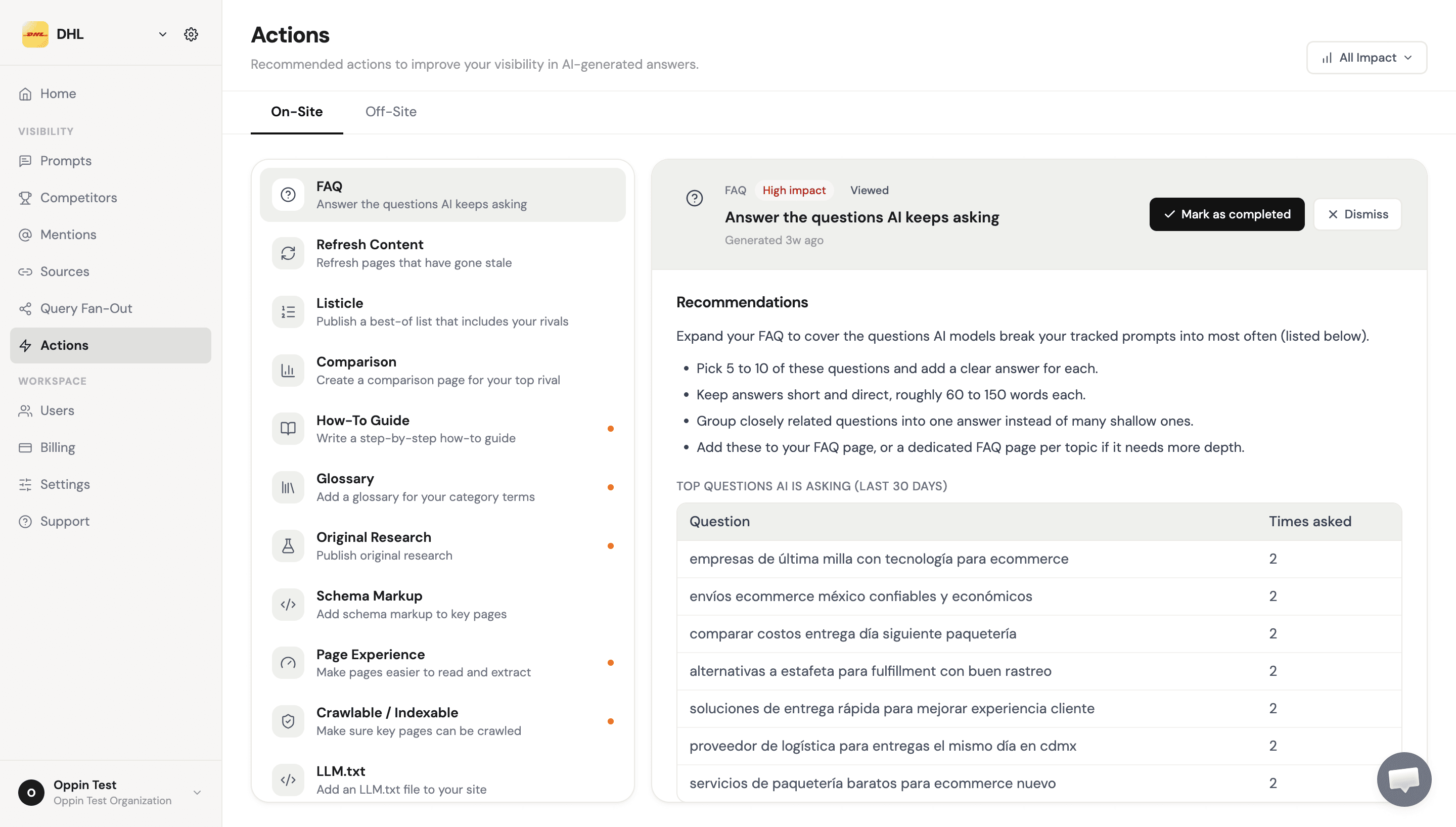
Measurement is only useful if it leads to better decisions.
This is where many AI visibility platforms stop.
Oppin goes one step further with Actions, which turns tracking data into a prioritized list of on-site and off-site improvements.
Instead of simply telling you:
“Your visibility is low for this topic.”
the goal is to help answer:
“What should I do about it?”
Depending on what the data reveals, opportunities may include improvements to:
Website content
Topic coverage
Landing pages
FAQs
Structured content
Third-party visibility
Sources influencing AI answers
Content gaps
Competitive gaps
The important principle is that recommendations should come from your actual AI search data rather than generic GEO checklists.
11. Track changes over time
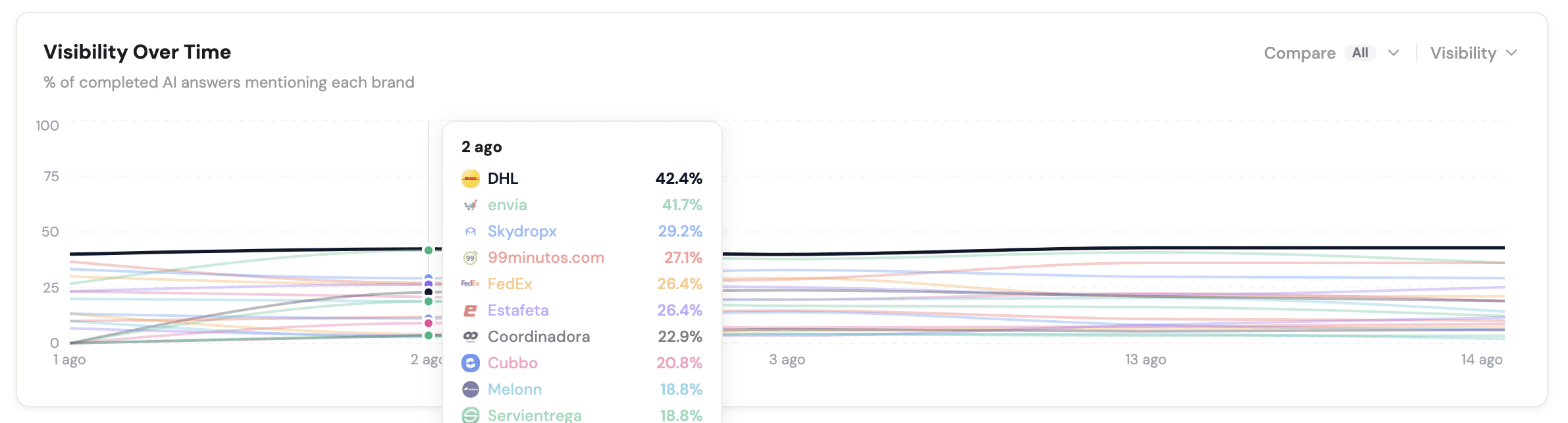
AI search results are not static.
Models change.
Sources change.
Competitors publish new content.
Your own website changes.
The answers users receive can change as well.
That means a one-time AI visibility audit is not enough.
You need continuous measurement.
Oppin runs tracked prompts daily, allowing you to monitor trends and compare your current performance with previous periods.
This creates a continuous GEO loop:
Track → Analyze → Improve → Track again
Over time, you can determine whether your optimization efforts are actually improving your presence in AI-generated answers.
What should you measure in AI search?
A strong AI visibility program should not rely on one metric.
Here is a practical framework:
Metric | What it tells you |
|---|---|
Visibility | How often your brand appears in AI answers |
Share of Voice | How much of the AI conversation belongs to your brand |
Position | Where your brand appears relative to competitors |
Top 3 Rate | How often your brand appears among the top three positions |
Sentiment | How favorably AI models describe your brand |
Brand Strength | Overall AI search performance across core signals |
Model Reach | How broadly your brand appears across AI platforms |
Sources | Which websites influence AI answers |
Citations | Which sources are surfaced in final answers |
Query Fan-Out | Which related searches influence AI responses |
Competitor data | Which brands are winning the same conversations |
The important part is how these metrics work together.
A high Visibility score with low Position can indicate that you are frequently mentioned but rarely recommended near the top.
A strong Share of Voice with negative Sentiment can indicate that your brand is prominent but being described poorly.
Strong performance on one AI platform but weak Model Reach can reveal a platform-specific gap.
This is why AI search visibility needs to be analyzed as a system rather than a single ranking.
How to build an AI search visibility workflow
A practical workflow for SEO and marketing teams looks like this:
Step 1: Define your important topics
Identify the products, services, categories, use cases, and buying decisions that matter most to your business.
Step 2: Create real-world prompts
Turn those topics into questions that potential customers might actually ask AI platforms.
Step 3: Track them across AI models
Monitor the same prompts across multiple platforms to identify differences in visibility.
Step 4: Establish your baseline
Record Visibility, Share of Voice, Position, Top 3 Rate, Sentiment, and Brand Strength.
Step 5: Identify competitors
Track the brands that consistently appear in your target answers.
Step 6: Investigate the winning answers
Read the actual AI responses to understand how your brand and competitors are described.
Step 7: Analyze sources and citations
Identify the websites and pages influencing the answers.
Step 8: Explore query fan-out
Understand the related searches AI models perform around your most important prompts.
Step 9: Prioritize actions
Use the data to decide which on-site and off-site improvements are most likely to strengthen your visibility.
Step 10: Measure again
Continue tracking after making changes so you can identify trends rather than relying on isolated results.
AI search visibility is the new layer of search measurement
SEO is not disappearing.
But search behavior is expanding.
People are increasingly asking AI systems to research products, compare companies, recommend services, explain solutions, and help them make purchasing decisions.
That creates a new surface where brands need to compete.
The fundamental challenge is simple:
You cannot optimize what you cannot measure.
AI search visibility tracking gives marketing and SEO teams the data needed to understand where their brand appears, how it compares with competitors, what influences AI answers, and where opportunities exist.
Oppin brings these pieces together by tracking real AI platform responses, analyzing brand performance across seven AI platforms, monitoring competitors, exposing sources and citations, measuring query fan-out, and turning the resulting data into prioritized actions.
The next generation of search visibility will not be defined only by where your website ranks.
It will also be defined by whether AI recommends your brand when your customers ask for the best answer.
And the first step toward improving that visibility is measuring it.
Oppin is verified as Software de Monitoreo de Redes Sociales en Mexico