10 Best AI Search Competitor Analysis Tools in 2026

Ricardo Matos
Listicle
Short answer
The best AI search competitor analysis tool depends on what you need to understand.
Some platforms are built mainly to track whether your brand appears in ChatGPT, Claude, Gemini, Perplexity, Google AI and other AI search engines. Others go further by showing which competitors are winning, which prompts they appear for, which sources influence those answers, and what content or marketing actions could close the gap.
For marketing teams, SEO agencies and SaaS companies, the most useful AI competitor analysis platforms in 2026 are Oppin, Profound, Semrush AI Visibility, Ahrefs Brand Radar, Similarweb AI Search Intelligence, Peec AI, OtterlyAI, Scrunch, AthenaHQ and Dageno AI.
The important thing is not to choose a platform based on the longest feature list. Look for one that lets you answer four questions consistently:
Which competitors are appearing instead of us?
Which prompts and topics are they winning?
Which sources are influencing those answers?
What should we do next?
AI search is becoming a larger part of how people discover and evaluate products. Google says AI Overviews now reach more than 2.5 billion monthly active users globally, while AI Mode has surpassed one billion monthly users. Microsoft Research also found that users engage more with generative AI content than traditional search results in a controlled eye-tracking study.
That makes competitor analysis in AI search less about watching a visibility number and more about understanding the competitive landscape behind the answers.
What is AI search competitor analysis?
AI search competitor analysis is the process of monitoring how your brand and competitors appear in AI-generated answers to the questions your customers ask.
Traditional SEO competitor analysis usually focuses on rankings, keywords, backlinks, traffic and content.
AI search competitor analysis adds another layer.
Instead of asking:
Which competitor ranks #1 for this keyword?
You ask:
Which brands does AI recommend when a buyer asks this question?
And then:
Which brand appears first?
Which brands are mentioned most often?
Which competitor is cited?
Which websites are influencing the answer?
Which prompts does my competitor win that I lose?
Is this happening in every market, or only in specific countries?
This distinction matters because AI search does not work like a traditional search results page.
Google explains that AI Overviews and AI Mode can use query fan-out, meaning a complex question can be broken into multiple related searches before the system generates the answer. The resulting response can therefore depend on more than the original wording of the user's prompt.
OpenAI also explains that ChatGPT Search can search the web and provide answers with links to relevant sources.
The result is a competitive environment where brands are competing for inclusion in a synthesized answer, not simply for a blue-link position.
Why traditional competitor analysis is not enough
A brand can rank highly on Google and still be barely visible in AI-generated answers.
The opposite can also happen.
A competitor may not dominate traditional rankings but could be repeatedly recommended by AI because its product positioning, third-party coverage, reviews, documentation or other sources are well represented in the information AI systems use.
This is why AI competitor analysis should not be treated as another keyword-ranking report.
A useful analysis should connect:
Prompts → AI answers → competitor mentions → position → share of voice → sources → citations → query fan-out → opportunities
That creates a much more actionable picture.

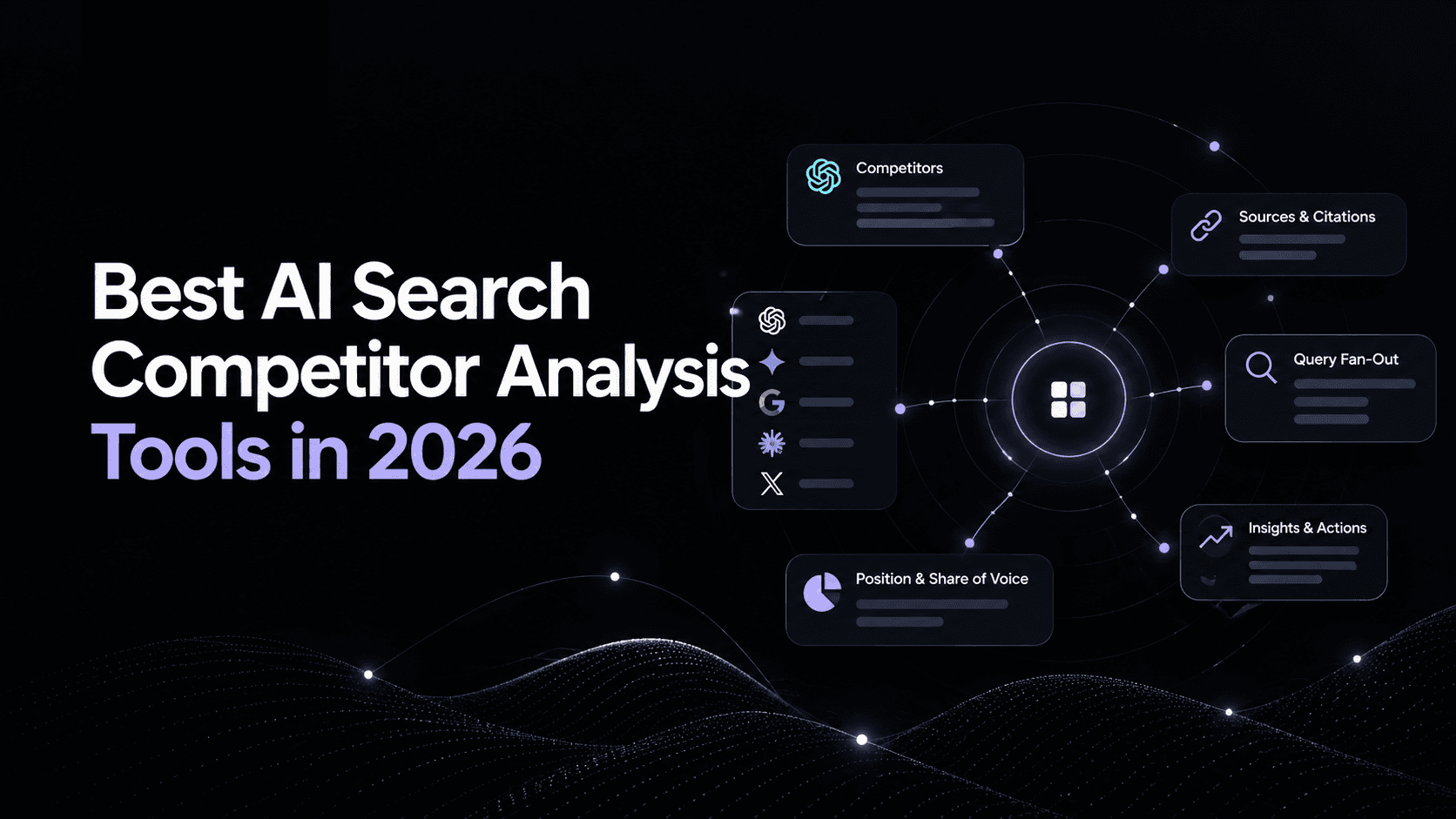
Image: Oppin's Competitor Analysis Infographic
For example, imagine an AI answer to:
What are the best customer support platforms for growing SaaS companies?
Your company is not mentioned.
A traditional SEO report might tell you that a competitor ranks for related keywords.
An AI competitor analysis platform can tell you something much more specific:
The competitor appears in 42% of tracked answers.
It is frequently listed in the top three recommendations.
Its own product page is cited in some answers.
Several software review websites are repeatedly cited alongside it.
Your brand appears for generic support queries but disappears when the prompt includes "SaaS".
AI search generates related questions around integrations, pricing, onboarding and scalability where the competitor remains visible.
Now you have a roadmap.
What should an AI search competitor analysis tool measure?
A useful platform should go beyond a simple "mentioned or not mentioned" metric.
1. Brand mentions
How often does each competitor appear in the monitored AI answers?
Mentions are the most basic competitive signal, but they are still important.

2. Visibility
What percentage of tracked responses include the brand? This is what the visibility score measure.
This creates a consistent baseline across prompts and time periods.

3. Position
When competitors are mentioned, where do they appear?
A brand mentioned in position one is competing differently from one mentioned in position six.

4. Share of Voice
How much of the competitive conversation does each brand capture? that's share of voice.
This is often more useful than an isolated visibility percentage because it provides context against the other brands appearing in the same answer set.

5. Sources and citations
Which pages and domains are influencing AI responses?
This is one of the most important parts of AI search competitor analysis.
A competitor may be visible because of its own website, but it may also be benefiting from reviews, listicles, publications, marketplaces, forums, directories, comparison articles or other third-party sources.

6. Prompt and topic gaps
Which questions generate competitor visibility while your brand remains absent?
This is where competitor analysis starts becoming a content strategy.

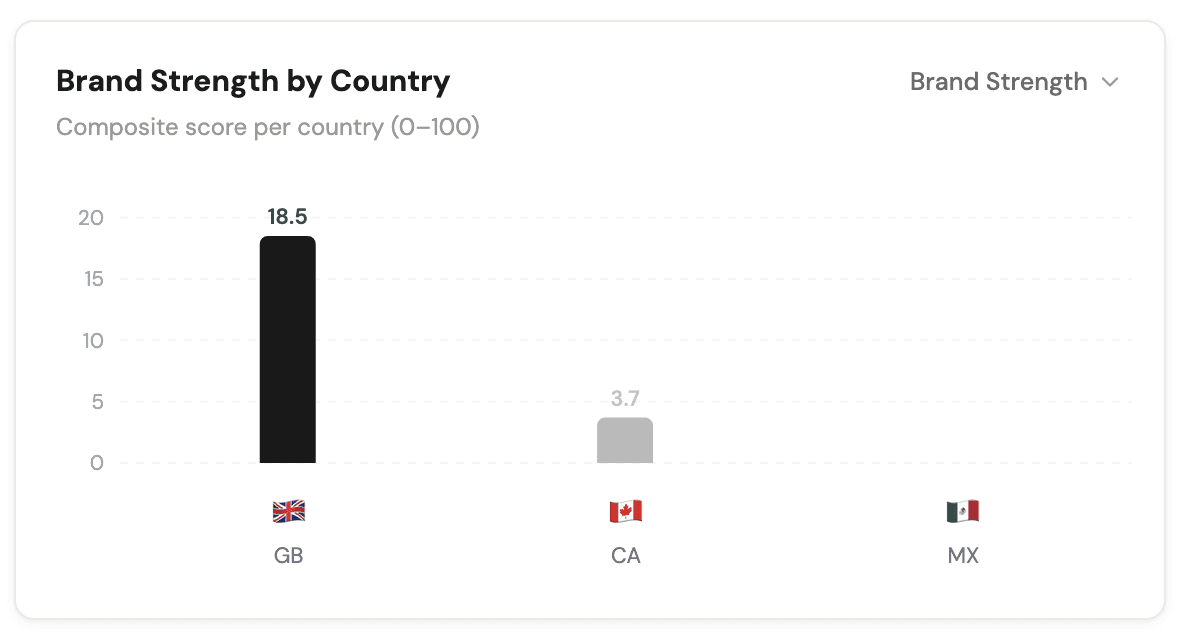
7. Geographic differences
Does a competitor dominate in the United States but not in Mexico, Spain, Brazil or the UK?
AI search results can vary by market, making country-level analysis particularly important for international companies.
8. Trend data
Is a competitor gaining or losing visibility over time?
A single AI answer is a snapshot. A repeated dataset lets you identify trends.

9. Actions
Can the platform help translate competitive intelligence into something your team can actually execute?
Those Actions could mean content improvements, source outreach, technical fixes, new pages or other GEO actions.

The 10 best AI search competitor analysis tools in 2026
We reviewed the tools based on competitor tracking, prompt-level analysis, source and citation intelligence, model coverage, geographic support, reporting and actionability.
There is no single platform that is the right fit for every company. This comparison is organized around use cases rather than a universal ranking.
Tool | Best for | Competitor analysis | Source / citation analysis | Starting price |
|---|---|---|---|---|
Oppin | Agencies, SaaS and multi-market teams | Yes | Yes | $129/mo |
Profound | Enterprise AEO programs | Yes | Yes | $99/mo |
Semrush AI Visibility | Existing Semrush users | Yes | Yes | $99/mo |
Ahrefs Brand Radar | Large-scale discovery | Yes | Yes | $199/mo |
Similarweb AI Search Intelligence | AI visibility + traffic intelligence | Yes | Yes | $99/mo |
Peec AI | Dedicated AI search analytics | Yes | Yes | $95/mo |
OtterlyAI | Smaller teams | Yes | Yes | $29/mo |
Scrunch | AI agent and technical intelligence | Yes | Yes | $250/mo |
AthenaHQ | Action-oriented GEO workflows | Yes | Yes | $295/mo |
Dageno AI | Competitive positioning and market intelligence | Yes | Yes | $79/mo |
Pricing and product details were checked against current public information in September 2026. Pricing, model coverage and feature limits can change, so verify the live plan before purchasing.
1. Oppin
Best for AI search competitor analysis across brands, markets and prompts
Oppin is an AI search visibility platform designed specifically around monitoring how brands and competitors appear in AI-generated answers.
The core workflow combines brand mentions, competitor tracking, positioning, share of voice, sentiment, sources, citations and Query Fan-Out analysis.
That last piece is particularly useful for competitive research.
Instead of only seeing that a competitor appeared in an answer, you can investigate the related searches that helped shape the answer and identify which queries your competitor captures that your brand does not.
Oppin also separates Sources from Citations.
That distinction matters because a page can influence an AI response without becoming a visible citation in the final answer.
Oppin supports tracking across ChatGPT, Gemini, Perplexity, Grok, Microsoft Copilot, Google AI Overviews, Google AI Mode and Claude, alongside country, language, topic and date filtering.
For teams that want competitor analysis to lead directly into execution, Oppin also provides Actions for on-site and off-site work.
Why consider Oppin
Unlimited competitors
Unlimited projects and users
Access to all AI models supported (Only Claude as add-on)
Multi-country tracking
Prompt-level competitor analysis
Sources and citations
Query Fan-Out
On-site and off-site actions
Daily tracking
Pricing
Oppin Startup starts at $129/month billed annually for 100 prompts and 9,000 analyzed AI responses per month. Pro is $299/month and Plus is $549/month.
Where it may not fit
Oppin is purpose-built for AI search and GEO. Teams looking for a broad traditional SEO suite with deep backlink and keyword research may still need another platform.
2. Profound
Best for enterprise AEO programs
Profound is one of the more enterprise-focused platforms in AI search.
Its Answer Engine Insights product lets teams compare brands across AI platforms, including visibility rank, share of voice, sentiment and citation performance.
One of its strongest competitive-analysis capabilities is identifying competitors based on who is actually winning AI citations, rather than relying only on a manually defined competitor list.
Profound also supports prompt-level competitive insights, competitor change monitoring and head-to-head comparisons between your content and the competitor pages being cited for a prompt.
The company also launched the Profound Index in 2026, built from more than 1.5 billion real user conversations across major LLMs, giving enterprise customers another layer of market-level benchmarking.
Why consider Profound
Enterprise AI search benchmarking
Competitive citation analysis
Prompt-level competitor analysis
Competitor change monitoring
AI traffic and crawler analytics
Agent workflows
Pricing
Profound's public self-serve pricing currently starts at $99/month for Starter, allowing you to track 50 prompts, with Growth at $399/month and Enterprise pricing available by quote.
Where it may not fit
The self-serve plans are more limited in model, language and country coverage. Larger multi-market implementations are more likely to require enterprise configuration and it can get pretty expensive for smaller and medium size companies.
3. Semrush AI Visibility
Best for teams already using Semrush
Semrush's main advantage is integration.
Its AI Visibility Toolkit puts AI competitor analysis alongside keyword research, backlinks, site auditing, content and broader SEO workflows.
The Competitor Research report lets users compare their brand with up to four competitors and identify topic and prompt gaps where rivals appear but the tracked brand does not.
The platform also provides competitor visibility, prompt research, brand performance, share of voice and sentiment analysis.
Semrush says its AI analysis uses a prompt database containing more than 317 million prompts and responses across ChatGPT, Gemini, Google AI Overviews and AI Mode, with rolling daily updates.
Why consider Semrush
AI competitor benchmarking
Prompt and topic gap analysis
Traditional SEO + AI visibility
Large AI prompt database
AI traffic and broader market intelligence options
Mature reporting ecosystem
Pricing
The AI Visibility product starts at $99/month per domain when billed annually. Semrush One starts at $199/month and combines AI and SEO capabilities.
Where it may not fit
Companies focused mainly on high-volume multi-brand AI search monitoring may find dedicated AI visibility platforms more straightforward.
4. Ahrefs Brand Radar
Best for large-scale AI search discovery
Ahrefs takes a different approach to AI competitor analysis.
Brand Radar gives marketers access to a huge pre-existing dataset of AI responses modeled from search-backed prompts.
Ahrefs says Brand Radar covers more than 475 million organic prompts in its current database and can be used to research brands, products, competitors, regions and authors.
That makes it particularly useful for discovery.
Instead of starting with a small set of prompts, you can investigate the broader AI search landscape around a category and then add specific buyer questions to custom tracking.
Brand Radar also connects AI visibility with SEO, YouTube, Reddit and TikTok signals.
Why consider Ahrefs
Very large AI search dataset
Competitive discovery
AI share of voice
Citation analysis
Strong connection between SEO and AI search
Custom prompt monitoring
Pricing
Brand Radar AI currently starts at $199/month. Separate custom prompt packages start at $50/month, depending on usage.
Where it may not fit
Teams that primarily want a simple fixed prompt-tracking workflow may find the combination of Brand Radar, indexes and custom checks more complex.
5. Similarweb AI Search Intelligence
Best for connecting AI visibility with traffic and market intelligence
Similarweb is particularly interesting for companies that do not want AI search analysis to exist in isolation.
Its AI Search Intelligence product combines AI brand visibility, prompt analysis, citation analysis, sentiment and AI traffic.
Similarweb also emphasizes real-user behavioral data and recently introduced Trending Topics to help teams understand changing AI search demand at the topic level.
Its competitor-analysis workflow includes comparing AI share of voice, prompts, citation sources and traffic impact.
Why consider Similarweb
AI competitor visibility
Citation analysis
AI traffic intelligence
Real-user behavior data
Topic trends
Broader digital competitive intelligence
Pricing
The standalone AI Search Intelligence package starts at $99/month when billed annually and includes 150 tracked prompts, AI brand visibility, sentiment, citation analysis and AI traffic. A broader AEO, SEO and competitive-intelligence package starts at $333/month billed annually.
Where it may not fit
Teams that only need a dedicated AI monitoring workflow may find the broader Similarweb ecosystem more than they need.
6. Peec AI
Best for dedicated AI search analytics
Peec AI is built specifically around AI search visibility analytics rather than traditional SEO.
Its platform lets teams compare competitors, track prompts, analyze visibility and review source behavior across AI search systems.
Peec's published plans currently include 50, 150 and 350 prompt tiers, with multi-country tracking and integrations becoming more available at higher plans.
Why consider Peec
AI-first product
Competitor tracking
Prompt monitoring
Visibility and position analysis
Source analysis
Multi-country support
Agency plans
Pricing
The current brand Starter plan is $95/month for 50 prompts. Pro is $245/month and Advanced is $495/month.
Where it may not fit
Teams that require very high model coverage or many projects should evaluate the cost of the required tier rather than comparing only headline pricing.
7. OtterlyAI
Best for smaller teams and lower-budget monitoring
OtterlyAI is one of the more accessible ways to start tracking AI search visibility.
Its analytics layer includes mentions, citations, sentiment, share of voice and competitor tracking. It currently monitors ChatGPT, Google AI Overviews, Perplexity and Microsoft Copilot in its base Lite plan, with additional engines available as add-ons.
The platform also supports competitor management, including AI-generated competitor suggestions based on brands already appearing in tracked answers.
Why consider OtterlyAI
Low entry price
Competitor tracking
Citation analysis
Prompt research
Daily monitoring
Unlimited team members
API and MCP on higher plans
Pricing
Lite starts at $29/month for 15 prompts. Standard is $189/month and Premium is $489/month on monthly billing. Additional AI models are available as add-ons.
Where it may not fit
The low-cost tier has a relatively small prompt limit, and expanding model coverage can increase the total cost.
8. Scrunch
Best for technical AI agent and website intelligence
Scrunch combines AI visibility tracking with a broader focus on how AI agents interact with websites.
The platform supports competitor analysis across mentions, citations, position, sentiment and other AI visibility metrics. Users can compare one or multiple competitors and filter results by topics, personas, funnel stage and other dimensions.
The differentiator is the Agent Experience Platform, which adds AI crawler activity, referral traffic and technical optimization.
Why consider Scrunch
Competitor visibility
Citations and sources
AI bot analytics
AI referral traffic
Technical AI optimization
Enterprise agent experience
Pricing
Scrunch Core starts at $250/month and includes 125 unique prompts, one brand workspace, five users and four AI platforms. Enterprise expands model coverage and adds API access, integrations and more workspaces.
Where it may not fit
The Core plan is centered around one brand workspace and four AI platforms, so larger international portfolios may require Enterprise.
9. AthenaHQ
Best for action-oriented GEO workflows
AthenaHQ focuses heavily on moving from insight to action.
The platform tracks AI visibility across a broad set of AI models and combines competitor monitoring with content recommendations, optimization workflows and AI agents.
Its competitor analysis capabilities include real-time competitor monitoring, source analysis and content gap identification.
Why consider AthenaHQ
Broad model coverage
Competitor monitoring
Source analysis
Content gaps
Optimization recommendations
AI agents
Agency capabilities
Pricing
AthenaHQ has a free Essential plan. Starter starts at $295/month and includes 3,600 credits, with broader API and enterprise functionality available through additional packages or custom plans.
Where it may not fit
Its credit-based pricing can be harder to compare directly with tools that price by prompts or analyzed responses.
10. Dageno AI
Best for competitive positioning and market intelligence
Dageno takes a broader market-intelligence approach to AI search competitor analysis.
Its competitive positioning workflow analyzes brand descriptions, attribute associations, competitor co-occurrence and recommendation context across models and markets.
Its competitor research workflow also lets teams inspect selling points, cited pages and the source domains associated with competitor visibility.
That makes Dageno particularly relevant when competitive analysis needs to go beyond simple mention counts and into positioning.
Why consider Dageno
Competitive positioning
Competitor recommendations
Brand perception analysis
Citation source analysis
Market intelligence
Prompt intelligence
Content and marketing agents
Pricing
Dageno's current Starter plan is $79/month for 50 prompts, three platforms and up to 10 competitors. Growth is $199/month and Scale is $499/month.
Where it may not fit
The platform combines several broader intelligence and agent capabilities, so teams looking only for straightforward daily prompt tracking may not need the full stack.
What our AI search sources study tells us about competitor analysis
One of the most useful signals in AI search competitor analysis is not the competitor itself.
It is the source ecosystem behind that competitor.
In an Oppin study of AI search sources across five e-commerce brands, editorial formats such as articles, listicles, reviews, comparisons and how-to guides represented 53.4% of total source use. Listicles also had a 39.8% use-weighted surfaced rate, while how-to pages reached 41.8%.
The study also found that 97.8% of source use occurred off the audited sites, reinforcing the importance of third-party coverage when trying to influence AI-generated answers.
This leads to an important competitive insight:
Your competitor's website is only one part of the reason AI may recommend them.
A competitor could be benefiting from:
Industry listicles
Comparison articles
Review websites
Media coverage
Community discussions
Product directories
Expert articles
Retail or marketplace pages
Its own documentation and product pages
That means a competitor analysis should not stop when you see:
Competitor X appears in 38% of answers.
The more useful question is:
Why does Competitor X keep appearing?
A practical framework for AI search competitor analysis
A good competitor analysis can be broken down into seven steps.
Step 1: Start with buyer prompts
Build a prompt set around the questions that matter commercially.
Include:
Category prompts
What are the best CRM platforms for small sales teams?
Use-case prompts
What is the best CRM for a SaaS company with a five-person sales team?
Comparison prompts
What should I compare when choosing a CRM for a growing startup?
Alternative prompts
What are the best alternatives to Salesforce for small teams?
Feature prompts
Which CRM platforms offer strong AI sales automation?
Industry prompts
What CRM tools are best for B2B SaaS?
Do not rely only on branded prompts.
A prompt such as:
Is [Brand] a good CRM?
mostly measures whether AI recognizes a company that the user already knows.
A non-branded prompt measures whether AI discovers that brand in the first place.
Step 2: Track competitors under the same conditions
Run the same prompts, models, countries and languages for every brand.
This matters because otherwise you may accidentally compare different datasets.
For each response, capture:
Prompt
AI platform
Country
Language
Date
Brand mentions
Brand position
Share of Voice
Sentiment
Sources
Citations
Competitors
Step 3: Find the prompts where competitors win
This is usually where the largest strategic opportunities appear.
Look for prompts where:
Competitor = mentioned
Your brand = not mentioned
Then group those prompts by topic and intent.
For example:
Topic | Competitor | Your brand | Opportunity |
|---|---|---|---|
Pricing | Mentioned | Missing | Pricing content |
Integrations | Mentioned | Missing | Integration pages |
SMB use case | Mentioned | Missing | Industry/use-case content |
Alternatives | Mentioned | Missing | Alternatives page |
Comparison | Mentioned | Missing | Comparison content |
This turns competitive intelligence into a content map.
Step 4: Analyze the source gap
Once you find a lost prompt, inspect the sources behind the answer.
Suppose a competitor is repeatedly appearing because AI is using:
A software review website
A comparison article
A respected industry publication
The competitor's product documentation
That tells you several things at once.
The competitor has a content opportunity.
It may also have a digital PR opportunity.
And it may have an authority advantage outside its own domain.
This is why source analysis matters so much in GEO.
Step 5: Analyze query fan-out
The original prompt is not necessarily the entire search process.
Google explains that AI Mode and AI Overviews can use query fan-out to issue multiple related searches.
For example:
What are the best project management tools for remote teams?
could lead to related searches involving:
Best remote project management software
Project management tools for distributed teams
async collaboration tools
project management pricing
project management integrations
best software for remote startups
If your competitor consistently captures those related searches, the competitor may be winning because of a broader topical footprint rather than one page.

Step 6: Turn competitive gaps into actions
A competitor gap is useful only when someone can act on it.
A practical action framework looks like this:
Competitor wins on comparison prompts
Create or improve comparison content.
Competitor wins on feature prompts
Strengthen product and feature pages.
Competitor wins through third-party sources
Invest in digital PR, partnerships, reviews or expert coverage.
Competitor wins on an industry-specific use case
Create dedicated industry content.
Competitor wins because of outdated information
Publish a clearer and more current primary source.
Competitor wins across query fan-out
Expand topical coverage instead of optimizing one page for one keyword.
Step 7: Track changes over time
Do not treat one AI answer as proof of a trend.
Run the same prompt set regularly.
Microsoft's AI Performance reporting is moving in the same direction, giving publishers more information about citations, grounding queries, topics and changes over time.
The strategic objective is not to react to every daily fluctuation.
It is to understand whether a competitor is consistently gaining or losing visibility within the conversations that matter.
AI search competitor analysis vs. traditional SEO competitor analysis
The two should not replace each other.
They answer different questions.
Traditional SEO | AI search competitor analysis |
|---|---|
Who ranks for this keyword? | Who gets recommended for this prompt? |
What is the ranking position? | What is the mention position? |
Who has more backlinks? | Which brands and sources shape the answer? |
What keywords are competitors targeting? | Which prompts and topics are competitors winning? |
Which pages rank? | Which pages are cited or influencing AI answers? |
What drives organic traffic? | Which AI platforms mention or refer traffic to competitors? |
How strong is the domain? | How strong is the brand's presence inside AI-generated answers? |
The strongest marketing programs will increasingly use both.
Google also explicitly says that the same foundational SEO best practices remain relevant for AI Overviews and AI Mode. There are no special technical requirements for appearing in those experiences beyond being eligible for Google Search.
How to choose the right AI competitor analysis tool
Instead of asking:
Which AI search competitor analysis tool is the best?
Ask:
Which competitive questions does my team need to answer?
Choose based on your workflow
You manage multiple brands and markets
Prioritize project scalability, country coverage, user access and competitor limits.
You are an enterprise AEO team
Look closely at enterprise governance, APIs, security, multi-brand support and advanced competitive benchmarking.
You already use Semrush or Ahrefs
The added value may come from connecting AI visibility with your existing SEO intelligence.
You want to understand AI traffic
Look for platforms with AI referral and traffic analysis.
You want to understand why competitors win
Prioritize prompt-level analysis, sources, citations and query fan-out.
You are an agency
Pay close attention to client workspaces, reporting, users, exports, APIs and total cost across your portfolio.
You want a low-cost starting point
Compare prompt limits, model coverage and add-on costs rather than looking only at the entry price.
The biggest mistake in AI competitor analysis
The most common mistake is treating competitor analysis as a leaderboard.
For example:
Competitor A: 42% visibility
Competitor B: 37%
Your brand: 18%
That is useful, but incomplete.
The number tells you that there is a gap.
It does not tell you why.
The real value comes from going one level deeper:
Which prompts create the gap?
Which topics create the gap?
Which competitors are winning those prompts?
Which sources support those competitors?
Which query fan-out searches are involved?
What can your marketing team change?
That is the difference between AI visibility reporting and AI search competitive intelligence.
Final thoughts
AI search competitor analysis is quickly becoming a distinct discipline inside SEO and marketing.
The platforms themselves are also moving in that direction.
Google is exposing more context around AI search experiences. Microsoft has introduced AI Performance, Topics, Intents, Citation Share and Compare in Bing Webmaster Tools.
The result is that competitive analysis no longer stops at:
Who ranks higher than us?
It is becoming:
Who is AI recommending, why are they being recommended, what sources are shaping that recommendation, and where are the opportunities for our brand?
That is the information marketing teams need to build a real GEO strategy.
For a broader overview of AI visibility platforms, see our guide to [10 Best AI Search Visibility Tools in 2026]. For a deeper look at the sources influencing AI answers, read our [AI Search Sources & Citations Study 2026]. And for a practical implementation guide, see [How to Track ChatGPT Brand Mentions, Sources and Citations].
Frequently asked questions
What is an AI search competitor analysis tool?
An AI search competitor analysis tool monitors how your brand and competitors appear in AI-generated answers. It can measure mentions, position, share of voice, citations, sources, prompts, sentiment and visibility trends across AI platforms.
How is AI competitor analysis different from SEO competitor analysis?
SEO competitor analysis usually focuses on rankings, keywords, backlinks and organic traffic. AI competitor analysis focuses on which brands AI systems recommend, which prompts they appear for, which sources influence those recommendations and how often competitors are cited.
Can you track competitors in ChatGPT?
Yes. Several AI search visibility platforms let you monitor competitors across ChatGPT and compare their visibility, position, mentions, citations and other signals against your brand.
How do I find competitors in AI search?
Start with a set of non-branded buyer prompts, run them consistently across your target AI platforms and record every brand that appears. Some AI visibility tools can also suggest competitors automatically based on the brands already appearing in tracked answers.
What is the most important metric for AI competitor analysis?
There is no single metric that tells the whole story. Visibility and mentions show presence, position shows prominence, Share of Voice provides competitive context, and sources and citations help explain why competitors are being surfaced.
Why are sources important in AI search competitor analysis?
Because a competitor can benefit from third-party sources even when its own website is not the main source being cited. Reviewing the source ecosystem can reveal digital PR, content, review and authority opportunities.
How often should I run an AI competitor analysis?
For important commercial prompts, daily tracking can provide a useful dataset. Strategic decisions should usually be based on weekly and monthly trends rather than a single response.
Can AI search competitor analysis help with GEO?
Yes. Competitive analysis is one of the most useful parts of GEO because it shows where competitors are winning, which sources influence those wins and which topics or prompts represent opportunities for your brand.
Does AI search replace SEO?
No. Google states that the foundational SEO best practices used for traditional Search remain relevant for AI Overviews and AI Mode. AI search adds another layer of measurement and optimization rather than making SEO irrelevant.
Can AI search competitor analysis identify content opportunities?
Yes. The most useful platforms connect competitor prompt gaps with source analysis, topic gaps and related searches so teams can turn competitive findings into content and distribution priorities.