How to Track ChatGPT Brand Mentions, Sources and Citations

Ricardo Matos
How to guides

The short answer
To track your brand in ChatGPT, monitor a fixed set of prompts and record three separate events: whether ChatGPT mentions your brand, whether your website or another page is used as a source, and whether that source appears as a visible citation. Then compare the results by prompt, topic, country, date and competitor.
A single search tells you what happened once. A useful ChatGPT brand monitoring program shows how often the pattern repeats, where competitors outperform you, and which pages influence the answers. If you need a broader overview across multiple AI platforms, start with our guide to tracking brand visibility in AI search.
The essential distinction A mention measures inclusion. A source measures influence. A citation measures visible attribution. A brand can win one of these without winning the other two. |
|---|
What ChatGPT brand tracking should measure?
OpenAI explains that ChatGPT can search the web for current information and that search-enabled responses may include citations. The interface can also show a Sources view with cited sources and other relevant links. OpenAI further notes that ChatGPT Search may rewrite one question into one or more targeted searches. These mechanics make the final answer only one layer of the research process. See OpenAI's current ChatGPT Search guidance for the product-level details.
Signal | What it means | What to record | Why it matters |
|---|---|---|---|
Brand mention | Your brand name or recognized product appears in the answer | Mentioned yes/no, wording, sentiment and position | Shows whether ChatGPT includes you in the conversation |
Source | A page or domain contributes information to the answer | Domain, URL, page type and ownership | Shows which content may be influencing the answer |
Citation | A source is visibly linked or attributed in the response | Citation URL, placement and whether it is owned or third party | Creates visible authority and potential referral traffic |
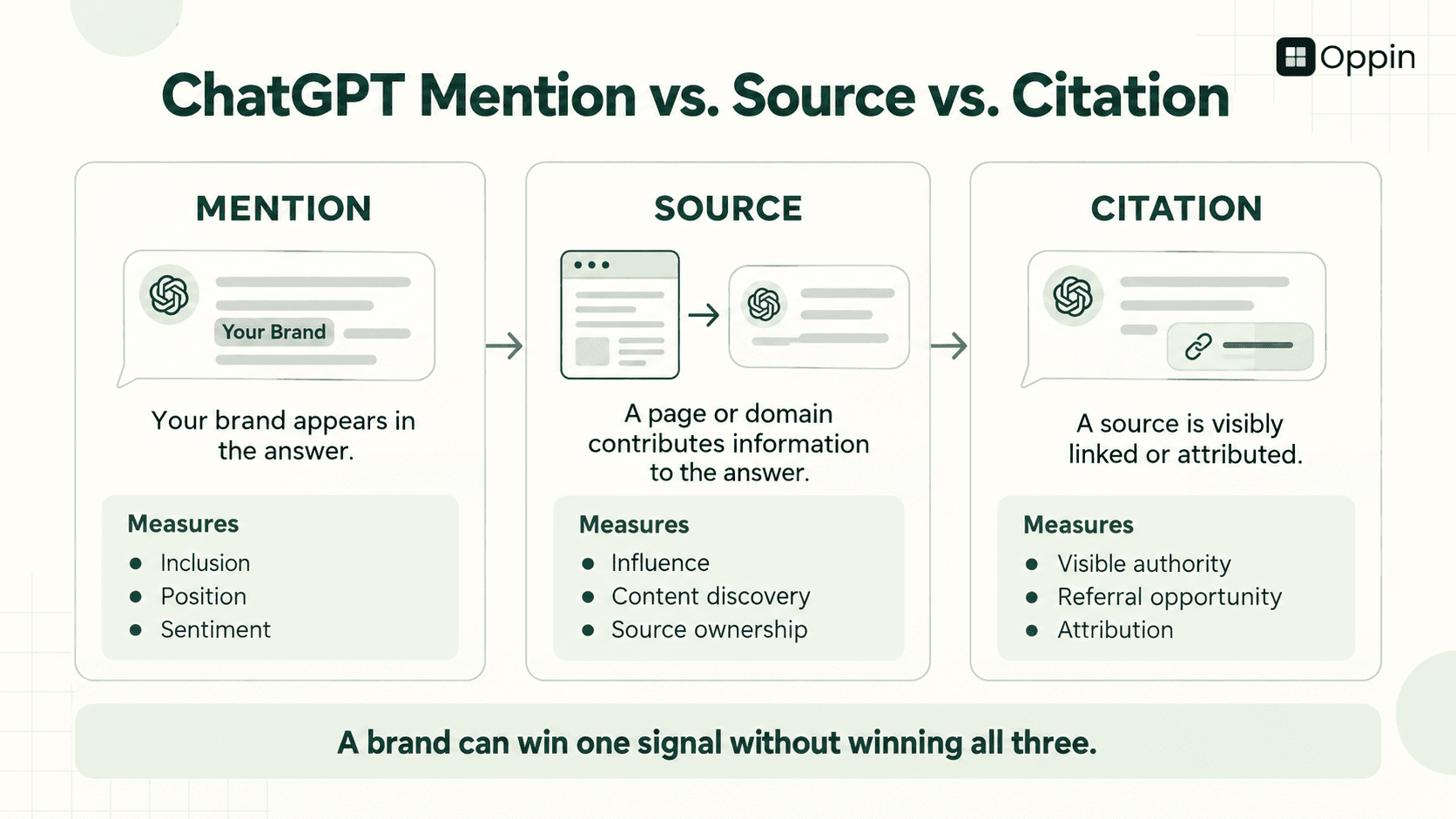
“A mention measures inclusion, a source measures influence, and a citation measures visible attribution.”
Four outcomes you will see in a real audit
Mentioned and cited. ChatGPT recommends the brand and shows a supporting link. This is the clearest visibility outcome, especially when the cited page belongs to the brand.
Mentioned without an owned citation. The brand appears, but the visible evidence comes from a publisher, marketplace, review site or competitor comparison page. Third-party influence may be doing more work than the brand website.
Sourced without a brand mention. A page may supply facts even when the final answer leaves the brand out. This can reveal useful content that is not yet connected strongly enough to the category or use case.
Neither mentioned nor sourced. Competitors and third-party pages control the answer. The next step is to inspect the repeated source set and identify the missing entity, content or distribution signals.
Oppin documents the same practical difference between sources and citations: a source can influence an answer without becoming a visible citation. Measuring only the links a user sees can therefore miss part of the picture.
Why manual spot checks are unreliable?
You can start with manual searches, but do not treat a handful of screenshots as a benchmark. ChatGPT answers can vary between runs, and web-search behavior can change with prompt wording, location, time and conversation context. OpenAI says approximate location and saved memory may affect how searches are rewritten, which is another reason to control your test conditions.
One prompt cannot represent an entire buying journey.
A branded prompt tests recall or reputation, not competitive discovery.
A visible citation does not reveal every page that may have influenced the answer.
A result without a date, country, prompt and saved response cannot be reproduced or compared later.
A mention count without competitor context does not show whether your share of the conversation is growing.
How to track ChatGPT brand mentions step by step
Step 1: Define the conversations that matter
Start with the questions a buyer asks before knowing which brand to choose. These should cover category discovery, use cases, comparisons, features, integrations, industries, pricing considerations and alternatives. Non-branded prompts reveal whether ChatGPT discovers your company on its own.
Intent | Prompt pattern | What it tests |
|---|---|---|
Category | What are the best [category] tools for [audience]? | Whether the brand enters the initial consideration set |
Use case | Which [category] is best for [specific job]? | Whether ChatGPT connects the brand to a real problem |
Feature | Which [category] tools include [feature]? | Whether product capabilities are understood |
Comparison | What should I compare when choosing [category]? | Which criteria and sources shape evaluation |
Alternatives | What are the best alternatives to [market leader]? | Whether the brand appears in replacement searches |
Branded | Is [brand] a good option for [use case]? | Accuracy, sentiment, objections and supporting sources |
Group prompts by topic so the final report can show where the brand is strong or absent. If you only produce one overall percentage, you will know that visibility is low but not which customer conversations need attention.
Step 2: Fix the variables before you collect answers
Use the same prompt wording, country, language, ChatGPT search setting and collection schedule for every run. Record the date and save the full answer. If a test requires local intent, specify the market rather than assuming the result is geographically neutral.
Keep branded and non-branded prompts in separate groups.
Run competitor prompts under the same conditions as your own.
Do not continue a long personal chat that contains unrelated memory or context.
Document any prompt or methodology change before comparing periods.
Step 3: Capture the full response
For each prompt, save the answer text, timestamp, market and every visible citation. Open the Sources view when it is available and record relevant links there as well. OpenAI warns that search results and citations can be incomplete, outdated or incorrect, so verify that a cited page actually supports the claim attributed to it.
Field | Example value | Purpose |
|---|---|---|
Prompt ID | CAT-CRM-014 | Keeps repeated runs comparable |
Topic | CRM for small sales teams | Enables topic-level analysis |
Country and language | United States, English | Controls market context |
Run date | 2026-09-17 | Creates a time series |
Brand mentioned | Yes | Calculates visibility |
Position | 2 | Shows prominence within the answer |
Sentiment | Positive / neutral / negative | Tracks how the brand is described |
Source URL | Publisher or owned page | Identifies influence |
Visible citation | Yes / no | Separates influence from attribution |
Competitors | Brands in the same answer | Supports share-of-voice analysis |
Step 4: Label mentions, sources and citations separately
Use a consistent rule for every response. Count a brand once per answer for visibility, even if the name appears several times. Record the first brand position separately. Then classify every source and citation as owned, competitor-owned or third party.
Owned source: a page on your website, documentation, support center or newsroom.
Competitor-owned source: a page controlled by another provider in the category.
Third-party source: a publisher, review site, marketplace, forum, research body or other independent domain.
Visible citation: a link or attribution the user can select in the answer or Sources interface.
Step 5: Calculate a baseline that competitors cannot distort
Your core visibility rate is the share of monitored answers that mention your brand. Position and Top 3 Rate show whether the brand is prominent. Citation rate shows how often your domain receives visible attribution. To judge competitive performance, add AI Share of Voice, which compares your appearances with all tracked brand appearances in the same response set.
Metric | Calculation | Question answered |
|---|---|---|
Visibility rate | Answers mentioning your brand / answers analyzed | How often do we appear? |
Average position | Sum of first mention positions / mentioned answers | How early are we recommended? |
Top 3 Rate | Top-three appearances / mentioned answers | How often are we a leading option? |
Owned citation rate | Answers citing your domain / answers analyzed | How often does our site earn visible attribution? |
Citation Share of Voice | Your cited appearances / total tracked cited appearances | How much visible authority belongs to us? |
AI Share of Voice | Your brand appearances / total tracked brand appearances | How much competitive attention do we capture? |
Step 6: Find the source gap behind every lost prompt
A missing mention is the start of the diagnosis. Open the answer and ask which pages repeatedly support the companies that appear. Look for sources that rank or compare the category, pages that define important use cases, and third-party sites that validate product claims.
If competitors are present on influential listicles and your brand is absent, the opportunity may be digital PR or editorial outreach.
If ChatGPT cites competitor documentation for a feature you also offer, your page may lack a clear, crawlable explanation.
If an old page supports an inaccurate claim, publish a clearer primary source and pursue corrections where appropriate.
If several lost prompts share one intent, build or strengthen the page that answers that intent rather than publishing unrelated posts.
This is where source analysis turns a visibility score into a content and distribution plan.
Step 7: Review the searches behind the original prompt
ChatGPT Search can rewrite a user question into more targeted searches. A broad prompt may lead to queries about pricing, features, alternatives, locations or current reviews. Those hidden variations help explain why a page appears even when it does not match the original wording exactly.
Use Query Fan-Out analysis to identify the phrases and subtopics that recur behind important prompts. Add the useful terms to the right existing page first. Create a new page only when the intent is distinct enough to deserve its own answer.
Step 8: Connect citations with site traffic
A citation is useful even when the user does not click, because it gives the answer visible support. Still, referral traffic should be measured separately. OpenAI says ChatGPT automatically includes utm_source=chatgpt.com in referral URLs and recommends using analytics platforms to track inbound traffic. The current guidance is available in OpenAI's publisher and developer FAQ.
Create a ChatGPT referral segment in your analytics platform.
Compare cited landing pages with the pages that actually receive ChatGPT referrals.
Track downstream actions such as sign-ups, demo requests, purchases or qualified sessions.
Do not use referral traffic as a substitute for visibility data. Many users may act later or search the brand directly.
Step 9: Repeat the test and review trends
Collect responses often enough to build a stable history, then make decisions from weekly and monthly patterns. A daily change may be noise. A repeated decline across one topic, market or citation source deserves investigation.
Daily: collect responses and flag major changes.
Weekly: review new competitors, lost prompts and source changes.
Monthly: evaluate visibility, position, sentiment, citations and share-of-voice trends.
Quarterly: refresh the prompt set as customer questions, products and markets change.
How Oppin automates the workflow?
Oppin runs tracked prompts daily and records the answer, brand appearances, competitors, position, sentiment, sources, citations and related searches. Teams can segment the results by AI model, country, language, topic and date instead of maintaining a manual spreadsheet.
Question | Oppin view or metric |
|---|---|
How often does ChatGPT mention us? | Visibility and tracked mentions |
Which brands appear before us? | Position, Top 3 Rate and competitor data |
How does our presence compare with competitors? | AI Share of Voice |
Which pages shape the answers? | Source domains and source pages |
Which links are visible to users? | Citations and citation metrics |
What searches happen behind the prompt? | Query Fan-Out |
What should we improve next? | Prioritized on-site and off-site Actions |
If you are choosing between manual monitoring and a dedicated platform, our comparison of AI visibility tools explains the workflow, coverage and reporting differences to consider.
How to improve ChatGPT mentions and citations?
There is no switch that guarantees a mention or citation. OpenAI states that search placement is not guaranteed. The practical goal is to make accurate information easy to retrieve and to build credible third-party evidence around the buying questions you want to win.
Make your site eligible for ChatGPT Search
OpenAI recommends allowing OAI-SearchBot and requests from its published IP ranges if you want pages to be eligible for ChatGPT Search results. The OpenAI crawler documentation also distinguishes OAI-SearchBot from GPTBot. OAI-SearchBot controls search discovery, while GPTBot relates to potential model training. The two settings can be managed independently.
Check robots.txt for accidental blocks on OAI-SearchBot.
Confirm that your CDN or security layer allows OpenAI searchbot traffic.
Keep important facts in crawlable HTML, not only inside images or client-side interactions.
Use canonical URLs, accurate titles and clear internal links so the right page is easy to identify.
Publish evidence that resolves a real question
Create clear product, feature, pricing, integration and use-case pages with verifiable details.
Publish first-party research, benchmarks and methodologies that other sites can reference.
Use comparison tables only when the criteria are transparent and the claims can be maintained.
Add concise definitions and FAQs where they genuinely answer recurring customer questions.
Show update dates and review time-sensitive facts rather than changing dates cosmetically.
Strengthen the third-party source layer
Your website is only one part of the answer. If the same publishers, directories, reviews or community pages recur across lost prompts, prioritize the relevant ones. Earn accurate inclusion through original research, expert contribution, product access, customer evidence or a clear correction request. Avoid mass outreach to sites that never appear in the source set.
Common tracking mistakes
Mistake | Why it fails | Better approach |
|---|---|---|
Tracking only branded prompts | It mostly tests known-brand recall | Use non-branded discovery prompts for the main benchmark |
Counting mentions only | It hides position, tone and source influence | Track position, sentiment, sources and citations too |
Treating Sources as citations | The two views measure different events | Store consulted sources and visible citations separately |
Testing once | One answer may be an outlier | Repeat the same prompt set and review trends |
Ignoring country and language | Local context can change results | Segment every run by market |
Changing prompts silently | The time series stops being comparable | Version the prompt set and record changes |
Optimizing from averages alone | Averages hide topic-level gaps | Inspect the prompts and sources behind each weak segment |
Assuming a citation is correct | A cited page may not support the claim | Open and verify every material citation |
Frequently asked questions
What counts as a ChatGPT brand mention?
A brand mention occurs when the company or a recognized product name appears in the answer. For a consistent visibility metric, count the brand once per response and record the first position separately.
Does ChatGPT always cite its sources?
No. OpenAI says web-search responses may include citations. The interface can also provide a Sources view when available. Citation behavior can vary by answer and search context.
Can a page influence an answer without a visible citation?
Yes. In a source-tracking workflow, a page can contribute information without being surfaced as a visible citation. This is why source analysis and citation tracking should be reported separately.
Can Google Analytics track traffic from ChatGPT?
Yes. OpenAI says referral URLs from ChatGPT include utm_source=chatgpt.com. Create a dedicated referral segment, then measure landing pages and conversions. Analytics will show visits, not every mention or citation that occurred without a click.
How often should ChatGPT visibility be tracked?
Collecting answers daily creates a useful history, but weekly and monthly trends are better for strategic decisions. Avoid reacting to a single answer or one-day movement.
What is the difference between ChatGPT visibility and Share of Voice?
Visibility measures how often your brand appears across tracked answers. Share of Voice measures your portion of all tracked brand appearances in the same competitive response set.
How can I increase the chance of being cited by ChatGPT?
Make important pages accessible to OAI-SearchBot, publish clear and verifiable information, keep time-sensitive facts current, and earn relevant third-party coverage on the domains that repeatedly influence your target prompts. Placement is never guaranteed.
Turn ChatGPT tracking into a weekly decision system
The useful question is not whether ChatGPT mentioned your brand once. It is where the brand appears consistently, which competitors take the leading positions, which pages support those answers, and what changed after your team acted.
A sound program keeps mentions, sources and citations separate, then connects them through the prompt and the source set behind it. That gives SEO, content, digital PR and product marketing teams a shared list of problems they can actually work on.
Start tracking your ChatGPT visibility with Oppin to monitor mentions, competitors, sources, citations and prompt performance in one workflow.